
PERSONAL INJURY LAW · SONG LAW FIRM COLUMN
Situation
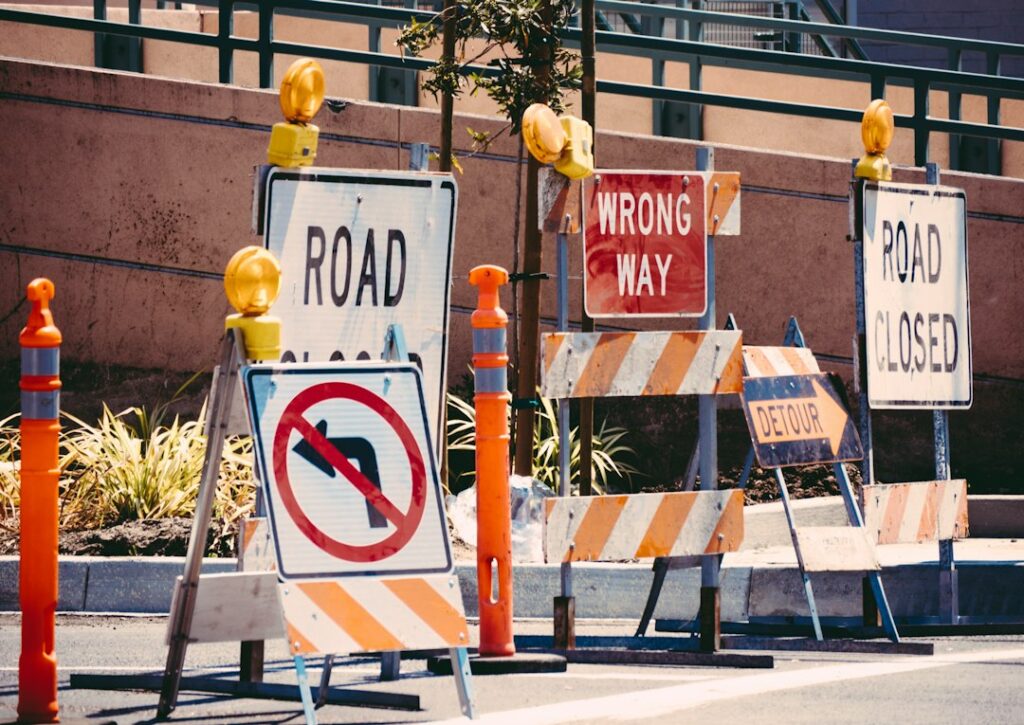
Every year, highway resurfacing, bridge repairs, utility work, and road widening projects turn familiar routes across New Jersey and New York into a maze of orange barrels, lane shifts, and temporary signs. Many drivers hurry through these areas, and some crashes there are caused by ordinary carelessness. But work-zone collisions are different from a typical rear-end or intersection crash in one important way: the road itself was deliberately changed by someone. When a lane suddenly narrows without enough warning, a pavement edge drops off several inches, cones are knocked over and never replaced, or a flagger is missing at night, the question of who is responsible can reach beyond the other driver.
This column explains how responsibility is divided among drivers, construction contractors, and public entities after a work-zone crash, why deadlines can be much shorter than people expect, and what evidence should be preserved right away.
Legal Concept
A work-zone crash claim usually rests on ordinary negligence: someone failed to use reasonable care, and that failure caused an injury. The difference lies in how many parties may have owed a duty of care.
- Other drivers must adjust speed and attention to the conditions, including reduced lanes, workers, and stopped traffic. Speeding, tailgating, or phone use in a construction zone is a classic basis for liability.
- Contractors and subcontractors who set up and maintain temporary traffic control can be liable if they do it negligently, for example by placing a lane closure too close to a curve, leaving a dangerous drop-off unmarked, or failing to maintain lighting and devices overnight.
- Public entities such as the State, a county, a municipality, or a toll-road authority may own the road and direct the project. Claims against them follow special statutory rules.
The national reference point for work-zone setup is the Manual on Uniform Traffic Control Devices (MUTCD). Part 6 of the MUTCD sets standards for temporary traffic control, including advance warning signs, taper lengths for lane closures, channelizing devices like cones and barrels, flagger procedures, and lane shifts. New Jersey follows the MUTCD. A setup that departs from these standards is not automatically negligence, but it is often strong evidence that reasonable care was not used.
NJ Rules
Several New Jersey rules shape these cases.
Higher fines in construction zones. New Jersey law increases, and for certain violations doubles, traffic fines in designated construction zones. A driver cited for speeding or another moving violation in a work zone may face heightened penalties, and the citation itself can support the injured person's negligence claim.
PIP pays first. If you are injured in a car crash in New Jersey, your own Personal Injury Protection (PIP) coverage is generally the primary source for medical bills regardless of fault. That does not change because the crash happened in a work zone.
Comparative fault. Under N.J.S.A. 2A:15-5.1, an injured person can recover damages as long as his or her share of fault is not greater than the combined fault of the defendants, and the award is reduced by that percentage. In work-zone cases, defendants often argue the driver should have slowed down more. A clear record of how the zone was actually set up helps answer that argument.
Claims against public entities: the 90-day notice. The New Jersey Tort Claims Act requires a written notice of claim to be presented to the public entity within 90 days after the claim accrues (N.J.S.A. 59:8-8). Missing this deadline can bar the claim except in limited circumstances. In addition, a public entity is liable for a dangerous condition of its property only if, among other things, its action or failure to act was "palpably unreasonable" (N.J.S.A. 59:4-2), which is a demanding standard.
Claims against private contractors. A private construction company is not a public entity, even when it works under a government contract. Claims against it generally follow New Jersey's two-year statute of limitations for personal injury (N.J.S.A. 2A:14-2). Because a single project may involve a public owner, a general contractor, a traffic-control subcontractor, and a paving subcontractor, identifying every party early is essential.
New York. For crashes in New York, claims against municipalities and many public authorities likewise generally require a notice of claim within 90 days (N.Y. General Municipal Law 50-e). Commuters who drive between New Jersey and New York should keep both systems in mind.
Practical Response
After a work-zone crash, the scene changes quickly. Crews move barrels, shift lanes, and repave within days. That makes early action important.
- Photograph and video everything if it is safe: warning signs (or their absence), cones and barrels, lane shift markings, pavement edges and drop-offs, steel plates, lighting conditions at night, and the position of any flagger.
- Record the contractor's name. It often appears on trucks, equipment, message boards, or project signs.
- Note project details such as permit numbers or project boards posted along the road.
- Get witness contact information, including workers who saw the crash.
- Request the police report and confirm it describes the work zone.
- Get medical care promptly and keep records, since PIP and any later claim depend on documented treatment.
- Calendar the 90-day public-entity deadline immediately if there is any chance a government body owns or controls the road.
Workers injured while on the job in a construction zone are generally handled through the workers' compensation system, which is a separate process not covered in this column.
Common Misunderstandings
"It was a crash with another car, so only that driver is responsible." Often the other driver is responsible, but a poorly designed or maintained work zone may share fault.
"I have two years to file, so there is no rush." That is generally true for private parties in New Jersey, but a claim against a public entity requires notice within 90 days.
"The contractor works for the State, so I can't sue it." Private contractors do not automatically receive the protections given to public entities.
"The scene will look the same later." Work zones change daily. Evidence disappears quickly.
Key Takeaways
- Work-zone crashes can involve drivers, contractors, subcontractors, and public owners.
- MUTCD Part 6 provides the benchmark for safe temporary traffic control.
- PIP generally pays medical bills first in New Jersey.
- Public-entity claims in NJ and NY generally require notice within 90 days.
- Photograph the zone and identify the contractor as soon as possible.
FAQ
Q. Do I need to prove the contractor violated the MUTCD?
Not necessarily, but evidence that the setup departed from MUTCD standards is often central to showing negligence.
Q. What if I was partly at fault?
Under New Jersey's comparative fault rule, you may still recover if your share of fault is not greater than the defendants', with damages reduced by your percentage.
If you or a family member was injured in a construction-zone crash, Song Law Firm can help identify every responsible party and protect the deadlines that apply to your case.
SONG LAW FIRM
Need advice on an auto accident or personal injury matter?
📞 201.461.0031 · ✉ mail@songlawfirm.com · 🌐 songlawfirm.com
📍 Parker Plaza, 400 Kelby Street, Suite 1900, Fort Lee, NJ 07024
