
PERSONAL INJURY · SUCCESS STORY
Client Profile
The client is a professional woman in her late thirties, of East Asian nationality, residing in Bergen County and commuting daily to Manhattan for a technology role. At the time of the accident she was a passenger in an Uber traveling near Route 4 in northern New Jersey. She was insured under her own New Jersey auto policy with $250,000 PIP limits and was additionally listed on her resident spouse's household auto policy, which became relevant to the PIP priority analysis. She had no prior musculoskeletal injuries of note and was in good general health before the collision.
Case Background
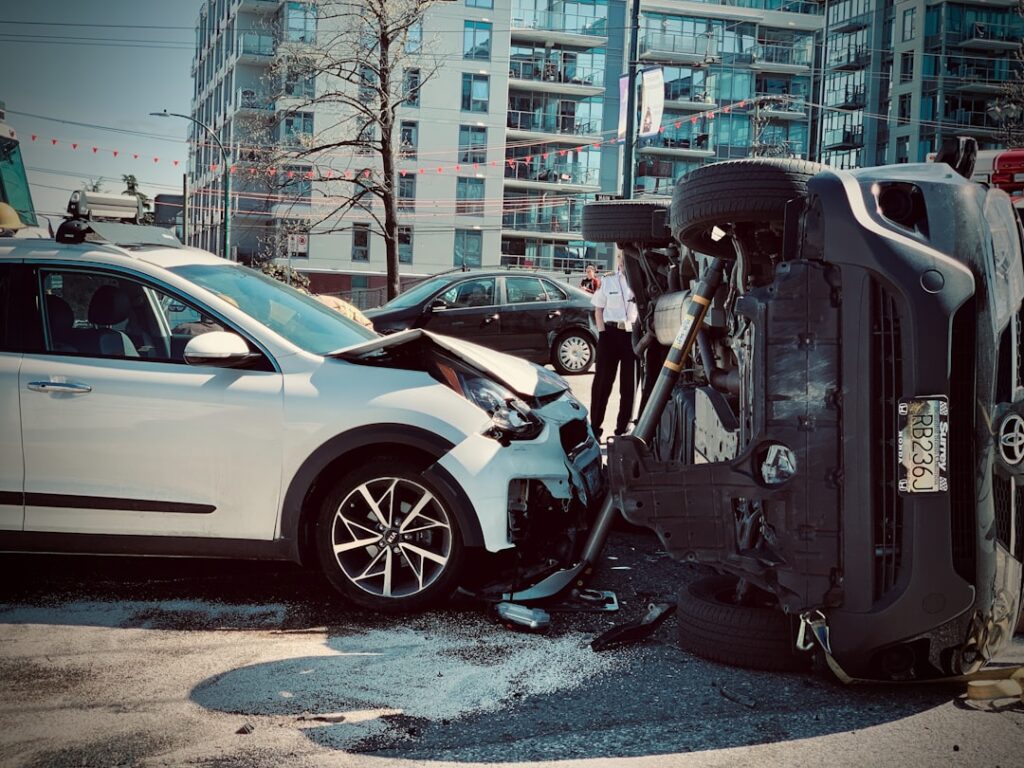
On a weekend afternoon the Uber driver was traveling eastbound on Route 4 during moderate traffic when the driver ahead braked sharply to avoid an obstruction. The Uber decelerated but was struck from behind by a large SUV that failed to brake in time, and the resulting force pushed the Uber into the vehicle ahead. This produced a three-vehicle sandwich collision with simultaneous front and rear impacts on the middle Uber vehicle. The client, seated in the rear left position, immediately reported cervical and lumbar pain, a persistent headache, and episodes of dizziness. Police responded to the scene, completed a formal accident report, and all three vehicles were towed. The client accepted transport to a nearby emergency department where initial radiographic screening ruled out fractures but flagged soft-tissue injury requiring follow-up.
Legal Issues
The core legal issues were four-fold. First, which insurance layer within the TNC framework applied to the client as a rideshare passenger during Period 3 of the trip. Second, verification of the rear SUV driver's liability policy limits, which would drive the ceiling of the third-party liability claim. Third, coordination of multiple PIP sources in the correct statutory priority order to avoid provider billing conflicts. Fourth, whether the client's cervical and lumbar injuries would meet the objective standard required by New Jersey's verbal threshold under N.J.S.A. 39:6A-8, since her policy carried the limitation-on-lawsuit option. Because the trip was in Period 3 (passenger onboard), the Uber TNC one-million-dollar primary policy was potentially triggered, and the rear SUV's liability policy represented a distinct recovery source that had to be pursued in parallel rather than in the alternative.
Song Law Firm Strategy
Song Law Firm implemented the following approach after the initial consultation. First, we secured contemporaneous screenshots of the Uber trip in the client's app, the emailed trip receipt, and the ride identification data, and we formally opened a claim with the TNC carrier before the ninety-day data purge window closed. Second, we obtained the rear SUV driver's auto policy declaration page to confirm the liability limits and to identify any excess coverage. Third, we activated the client's personal PIP in the correct statutory priority so treatment providers could bill without interruption — an important step to preserve the client's relationships with orthopedic, pain management, and physical therapy providers in the Bergen County corridor. Fourth, we documented the cervical and lumbar findings through MRI imaging, which confirmed disc bulges and nerve root irritation, providing the objective medical basis required to meet the verbal threshold. Fifth, we preserved a UM/UIM analysis in reserve in case the combined TNC and third-party limits proved insufficient.
Process
Within approximately two weeks of the accident, PIP claims were open and treatment funding was stabilized so the client could focus on recovery rather than billing disputes. Three to four months of active physical therapy, pharmacologic pain management, and orthopedic follow-up ensued, punctuated by follow-up imaging. After the client's treating physicians formally recognized maximum medical improvement (MMI), Song Law Firm assembled a comprehensive demand package that quantified medical specials, lost income during recovery, and pain-and-suffering damages under the verbal threshold analysis. Demand letters were transmitted simultaneously to the TNC carrier and to the rear SUV liability carrier. Several rounds of structured negotiation and adjustment followed, including a period during which the TNC carrier initially disputed the injury causation. Ultimately the matter resolved through negotiated settlement. The total time from the accident to final resolution was within approximately four years.
Result
The client received a comprehensive recovery that covered documented medical expenses, verified lost income, and pain-and-suffering damages consistent with her verbal-threshold-qualifying injuries. Specific dollar figures are not disclosed in accordance with client confidentiality. The final settlement represented a meaningful increase over the insurers' initial valuations, reflecting the strength of the objective imaging and the properly sequenced claims strategy. After concluding treatment the client returned to normal work and daily commuting activities.
Lessons
This matter illustrates four practical lessons for Uber and Lyft passenger cases in New Jersey. First, immediate preservation of rideshare app data is decisive: ride IDs, driver information, vehicle information, and trip receipts often become inaccessible after the ninety-day data purge window, and no amount of later effort can substitute for contemporaneous screenshots. Second, sequential activation of multiple insurance layers — TNC primary, third-party liability, personal PIP, and UM/UIM in reserve — maximizes the client's recovery while avoiding coverage denials. Third, objective imaging and clear treatment records are essential to satisfying the verbal threshold under N.J.S.A. 39:6A-8; subjective complaints alone are rarely sufficient. Fourth, settling before reaching MMI is almost always premature because the true severity, duration, and permanency of the injuries have not yet been documented, and early settlement often forecloses meaningful recovery. Under NJ Rules of Professional Conduct 7.1, past results do not guarantee similar outcomes; each case depends on the specific facts, available evidence, and insurance conditions. If you have been in a similar rideshare accident, an initial consultation can clarify the scope, sequence, and timing of your potential claims.
SONG LAW FIRM
Schedule an initial consultation.
📞 201.461.0031 · ✉ mail@songlawfirm.com · 🌐 songlawfirm.com
📍 Parker Plaza, 400 Kelby Street, Suite 1900, Fort Lee, NJ 07024
