
PERSONAL INJURY LAW · SONG LAW FIRM COLUMN
Situation
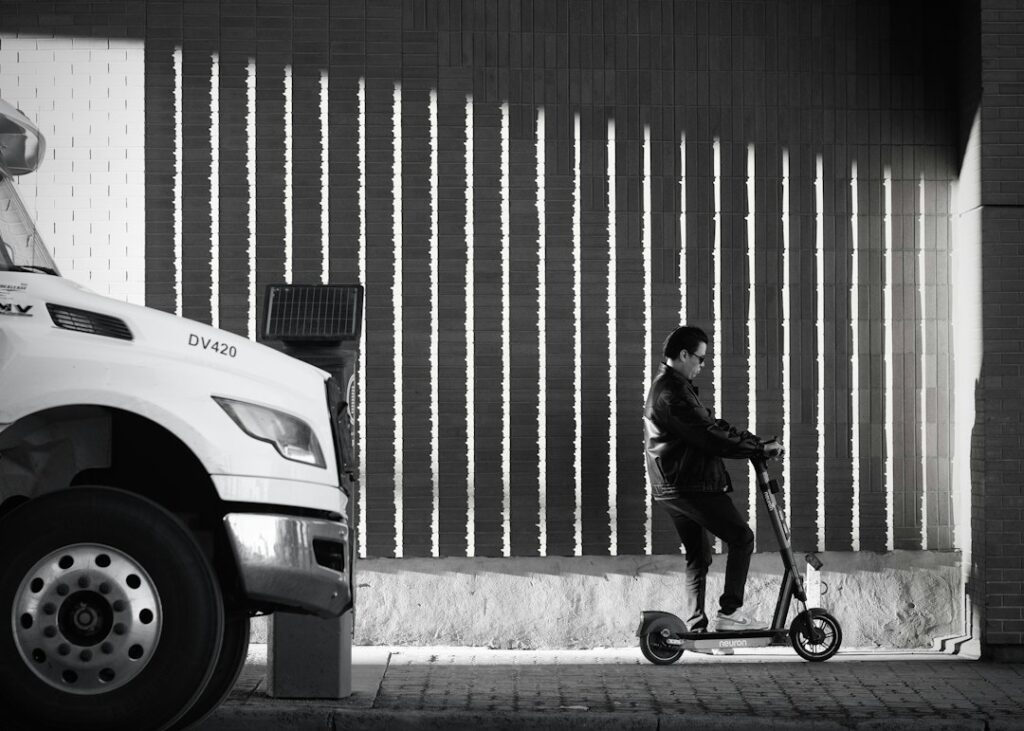
Electric scooters have become a common sight in Jersey City, Hoboken, Newark, New Brunswick, and throughout New York City. Some belong to individual riders; others are rented through shared-scooter apps under municipal programs. They are convenient and quiet, which is exactly why pedestrians are often caught off guard. A scooter moving quickly on a crowded sidewalk, cutting through a crosswalk, or swerving around a parked car can knock a person to the ground. Older adults and children are especially vulnerable, and injuries such as wrist and hip fractures, head injuries, and facial lacerations are not unusual.
When a pedestrian is hit by a car, there is a well-established insurance system to turn to. When the pedestrian is hit by an e-scooter, many people discover that the usual system does not apply. This column explains why that gap exists in New Jersey, where compensation can come from, and what to do after the incident.
Legal Concept
The core legal claim is ordinary negligence. A scooter rider, like any other person, must use reasonable care for the safety of others: watching for pedestrians, riding at a safe speed, yielding where required, and obeying local rules about where scooters may be ridden. If the rider failed to do so and that failure caused your injury, the rider can be held responsible for your damages, including medical expenses, lost income, and pain and suffering.
The difficulty is usually not proving fault. It is finding a source of payment.
NJ Rules
How New Jersey treats e-scooters. In 2019, New Jersey enacted a law (P.L.2019, c.128) that defined low-speed electric scooters and generally treats them like bicycles for purposes of road rules. Riders have rights and duties similar to cyclists. Many municipalities add their own ordinances, including restrictions on riding on sidewalks, so the rules can differ from town to town.
Why auto PIP generally does not help. New Jersey's Personal Injury Protection (PIP) coverage pays medical expenses for a pedestrian who is struck by an automobile. An e-scooter is not an "automobile" under New Jersey's auto insurance law. As a result, a pedestrian hit by an e-scooter generally cannot use his or her own or a household member's auto PIP for treatment. This surprises many people who assume their car insurance covers any traffic-related injury.
No mandatory insurance for riders. New Jersey generally does not require e-scooter riders to carry liability insurance the way it requires car owners to do. Many riders have no insurance that specifically covers scooter accidents.
Comparative fault. Under N.J.S.A. 2A:15-5.1, an injured pedestrian can recover as long as his or her share of fault is not greater than the fault of the defendants, with damages reduced by that percentage. A rider may argue the pedestrian stepped suddenly into the scooter's path; witness statements and video become important.
Deadlines. A personal injury lawsuit in New Jersey generally must be filed within two years (N.J.S.A. 2A:14-2). In New York, the general deadline is three years (CPLR 214(5)).
Practical Response
Possible sources of compensation include the following, and each must be checked individually:
- The rider's homeowners or renters insurance. These policies often include personal liability coverage. However, many policies exclude injuries arising from motorized vehicles, and whether an e-scooter falls within that exclusion depends on the exact policy language.
- The shared-scooter operator's insurance. If the scooter was rented, the operating company may carry liability coverage, and municipal permit programs may require operators to maintain insurance. Whether it covers a particular incident depends on the policy and the facts.
- The rider personally. A rider without insurance can still be held liable, although collecting a judgment depends on the rider's assets.
- Your own health insurance. Even when liability coverage is uncertain, your health insurance can usually cover treatment so care is not delayed. The health plan may later seek reimbursement from any recovery.
Rental-app terms of service, including arbitration clauses, generally bind the riders who accepted them. A pedestrian who never signed up for the app is generally not bound by those terms, although operators may raise arguments depending on the circumstances.
Evidence to collect right away:
- The scooter's ID number or QR code, and the operator's name if it was a shared scooter
- The rider's name, phone number, and address
- Photos of the scene, the scooter, your injuries, and the sidewalk or street conditions
- Names and contact information of witnesses
- Locations of nearby security or traffic cameras, since footage may be overwritten quickly
- A police report; ask officers to document the scooter details
- Prompt medical records
Riders sometimes leave the scene quickly. Even a photo of the scooter's ID can make it possible to identify the rental account later.
Common Misunderstandings
"My car insurance covers me as a pedestrian." For a collision with a car, generally yes. For an e-scooter, auto PIP generally does not apply.
"The scooter company is automatically responsible." Not necessarily. Responsibility depends on the facts and the applicable insurance; the rider's negligence is usually the central question.
"Without insurance, there is no point in pursuing a claim." Several sources may need to be examined, including homeowners, renters, and operator policies, before reaching that conclusion.
"Minor-looking injuries don't need a doctor." Head injuries and fractures in older adults can worsen without early treatment, and records matter for any claim.
Key Takeaways
- E-scooters are generally treated like bicycles under New Jersey road rules.
- Auto PIP generally does not cover a pedestrian struck by an e-scooter.
- Riders are generally not required to carry insurance in New Jersey.
- Check the rider's homeowners or renters policy, the operator's coverage, and your own health insurance.
- Record the scooter ID and operator immediately; NJ's deadline is generally two years, NY's three years.
FAQ
Q. The rider ran away. What can I do?
If it was a shared scooter, the scooter ID, time, and location may allow the operator's records to identify the rental account. Report it to police promptly.
Q. Does the town share responsibility?
Rarely. Claims against public entities involve special rules and short notice deadlines, so evaluate them early if a road or sidewalk defect contributed.
If you or a family member was injured by an e-scooter, Song Law Firm can help identify the available insurance and plan a path toward compensation.
SONG LAW FIRM
Need advice on an auto accident or personal injury matter?
📞 201.461.0031 · ✉ mail@songlawfirm.com · 🌐 songlawfirm.com
📍 Parker Plaza, 400 Kelby Street, Suite 1900, Fort Lee, NJ 07024
