
IMMIGRATION LAW · SONG LAW FIRM SUCCESS STORY
Client Profile
A scholar in her early forties from an East Asian country of origin, working in a natural science field with substantial cross-disciplinary reach. After earning a doctorate at a leading university in her home country, she completed a series of postdoctoral appointments at research universities in Europe and the United States, developing an independent line of research over roughly a decade and building a network of collaborators across three continents. Her publication record grew steadily during that period, and she began to be invited to speak at international conferences and to review manuscripts for journals outside her original home network — early external signals of the recognition that later supported the EB-1B filing. She was then recruited through an international faculty search to a tenure-track assistant professor position at a comprehensive four-year university in the Eastern United States. Shortly after her appointment was finalized, her long-term plan to settle in the United States, her interest in supervising doctoral students on multi-year projects, and the university's onboarding conversations led her to consult Song Law Firm regarding an EB-1B petition rather than the default EB-2 route.
Case Background
The university had already extended a written permanent job offer conditioned on the standard tenure review track, with an anticipated review at year six and a lab space and startup package commensurate with a tenure-track position. However, the university's International Scholars Office traditionally advised newly hired faculty to file under EB-2 National Interest Waiver, or through the university-sponsored EB-2 or EB-3 routes, and had comparatively limited internal experience with the EB-1B pathway. The scholar herself had received several international conference awards, served as a peer reviewer for multiple journals, sat on the editorial board of one specialty publication, and maintained a citation record in the upper range for her cohort. Based on this profile she believed EB-1B was worth exploring, especially given the growing backlog in some EB-2 categories, and she requested an initial consultation with Song Law Firm to evaluate her eligibility and the evidentiary path.
Legal Issues
EB-1B (Outstanding Professor or Researcher) is the second subcategory of EB-1 priority workers. Unlike EB-1A, EB-1B requires a permanent job offer from a U.S. employer — most commonly a tenure or tenure-track appointment, or a research position at a university, institution of higher education, or private employer that is either of indefinite duration or supported by a written commitment of at least three years. Self-petitioning is not permitted, which makes the framing and drafting of the employer's job offer letter a substantive part of the petition, not merely a formality.
To qualify, the petition must document at least two of the following six regulatory criteria:
- Receipt of a major prize or award for outstanding achievement in the academic field
- Membership in associations that require outstanding achievements of their members
- Published material in professional publications written by others about the beneficiary's work in the academic field
- Participation, either individually or on a panel, as the judge of the work of others in the same or an allied academic field
- Original scientific or scholarly research contributions to the academic field
- Authorship of scholarly books or articles (in scholarly journals with international circulation) in the academic field
The beneficiary must also demonstrate at least three years of experience in teaching or research in the academic field and, on the whole record, that she is internationally recognized as outstanding. USCIS applies a two-step analysis under Kazarian: first counting whether at least two criteria are met, then conducting a final merits determination on whether the totality of the evidence shows international recognition.
Song Law Firm Strategy
At intake, Song Law Firm rebuilt the client's résumé into a criterion-by-criterion evidence matrix rather than filing her CV as narrative alone.
- Peer review: We collected editor invitations, review completion confirmations, and journal records from more than three peer-reviewed publications to document sustained judging of others' work, and we obtained a short letter from one editor-in-chief confirming that the client had been invited specifically because of her recognized expertise.
- Original contribution and authorship: We selected the client's most-cited articles, prepared a citation summary comparing her indicators against her sub-field, and drafted plain-language explanations of the scholarly impact and downstream use of each contribution — including citations in industry white papers and standards documents where available.
- Prizes: For three international awards, we documented the sponsoring organization, the competitive pool, the selection procedure, and the standing of the award in her field so that USCIS could evaluate them as major prizes rather than routine internal honors.
- Membership: For scholarly society memberships, we submitted charter excerpts and bylaws confirming that membership required outstanding achievement judged by recognized experts, not merely payment of dues.
- Recommendation letters: We solicited six letters from independent experts inside and outside the client's home country, structured to speak to specific criteria rather than generic praise.
We also worked with the university's HR office to reissue the permanent job offer letter with clear language on the tenure track, review milestones, lab allocation, and the indefinite nature of the appointment following tenure. To preempt any USCIS concern about the employer's ability to sustain the position, we included the institution's most recent financial summary and a written commitment to continuing employment during and after adjudication.
Process
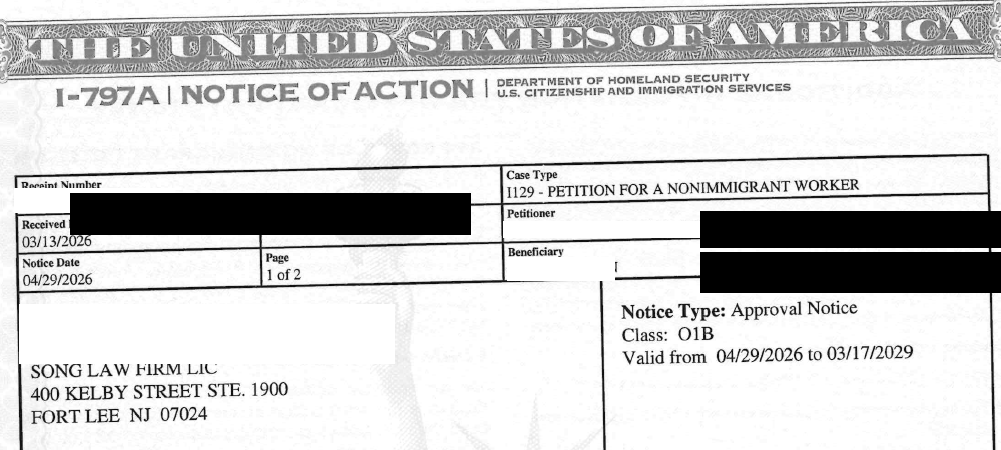
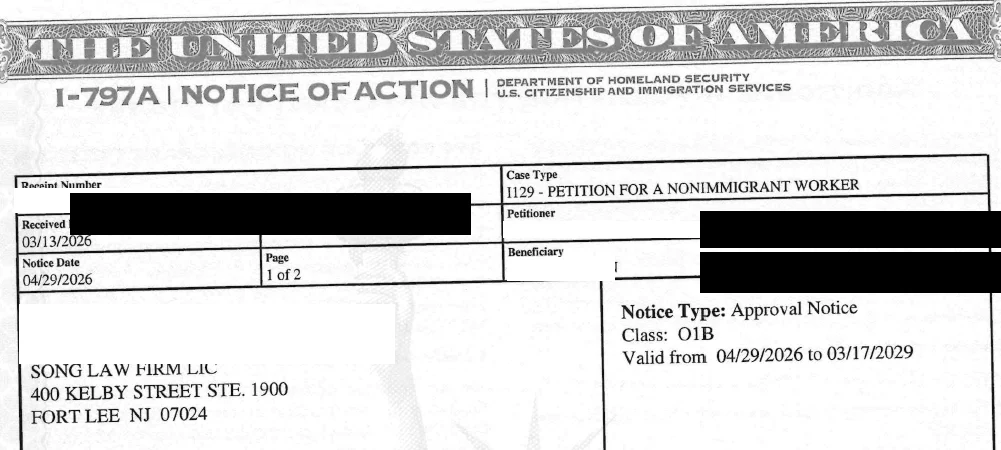
After drafting the petition, we conducted two remote review sessions with the client — one to walk through the evidence matrix and expert letter drafts, and one to finalize the personal statement and confirm the exhibit index. During the second session we also mapped out contingencies in case USCIS issued an RFE on comparable evidence for the awards criterion or on the international-recognition final merits step, so the client and the university would not be surprised by any later request. We then filed the complete package under Premium Processing, submitting exhibit-tab bookmarks and a criterion-by-criterion cover memorandum to help the adjudicator navigate the record. Within approximately two weeks of filing, USCIS issued an approval notice with no request for evidence. The approval notice was promptly shared with the university's HR office and the International Scholars Office so that adjustment of status planning, or consular processing where applicable, could begin without delay and without a gap in her research operations, and so the university could complete its internal onboarding checklist for the sponsored appointment.
Result
The I-140 EB-1B petition was approved within the Premium Processing window with no RFE. The client can continue her tenure-track appointment while advancing to the next stage of permanent residence. Because EB-1B alone was sufficient, we did not need to file a parallel EB-2 NIW petition, saving both filing time and cost, and we preserved the option to pursue an earlier priority date under EB-1 preference categories in future demand cycles. The approval also gave the sponsoring department the certainty to move forward with longer-term commitments — graduate advising, multi-year grant applications naming the client as principal investigator, and internal recruiting for her research group — without conditioning those plans on immigration risk. From the client's perspective, the approval removed the recurring uncertainty of a non-immigrant renewal cycle and let her focus on the tenure clock rather than on visa strategy.
Lessons
For scholars who have secured a tenure-track appointment at a U.S. university, EB-1B is often a faster and more efficient path than EB-2 NIW, particularly when the applicant already has a documented record of peer review, original contributions, and international recognition. Even when an International Scholars Office defaults to EB-2 filings, an initial consultation with outside immigration counsel can identify whether EB-1B is available and how to organize the evidence for USCIS. Peer review, original contribution, and journal authorship are common academic activities, but they must be documented against the specific regulatory criteria — with third-party corroboration and independent expert letters — to be recognized. A well-drafted permanent job offer letter is equally important: language that clearly describes tenure-track status, review milestones, and the indefinite nature of the position after tenure carries substantive weight in adjudication, whereas boilerplate offer letters can invite avoidable questions. Song Law Firm brings EB-1B experience across academic disciplines and helps clients rebuild an evidence matrix, refine the permanent job offer letter with the sponsoring institution, coordinate with the International Scholars Office on internal HR requirements, and choose an appropriate Premium Processing strategy tailored to the client's timeline, tenure clock, and downstream family and adjustment-of-status plans.
SONG LAW FIRM
Facing a similar immigration matter? Schedule a consultation today.
📞 201.461.0031 · ✉ mail@songlawfirm.com · 🌐 songlawfirm.com
📍 Parker Plaza, 400 Kelby Street, Suite 1900, Fort Lee, NJ 07024
