
IMMIGRATION LAW · SONG LAW FIRM CASE STUDY
Client Profile
A Korean-American creator or designer in the 30s–40s range who has been active in the fashion and design industry for many years and has earned international recognition. Their track record includes collection presentations, participation in international fashion weeks, brand collaborations, design awards, and press coverage, and they were maintaining U.S. activity in O-1 or another nonimmigrant status. This case study reflects the common pattern of Song Law Firm's EB-1 matters in the fashion and design field, where a nonimmigrant status extension was pursued in parallel.
Case Background
The client group sought to transition to the lawful permanent residence stage to sustain continued U.S. activity, and needed to map creative and design accomplishments to the EB-1A criteria rather than relying on the publication-driven profile more typical of traditional EB-1 filings. At the same time, given the impending expiration of the existing nonimmigrant status, the EB-1 petition and status extension had to be designed in parallel.
Legal Requirements
The legal basis for EB-1 Extraordinary Ability is INA § 203(b)(1)(A); 8 C.F.R. § 204.5(h); and the Kazarian v. USCIS, 596 F.3d 1115 (9th Cir. 2010) two-step analysis. USCIS Policy Manual Volume 6, Part F, Chapter 2 sets out the detailed standard.
The 10 regulatory criteria are: nationally or internationally recognized prizes; memberships requiring outstanding achievement; published material about the alien; judging others' work; original contributions of major significance; scholarly articles; artistic exhibitions or showcases; leading or critical role in distinguished organizations; high salary; and commercial success in the performing arts. In the arts and design fields, the exhibitions/showcases criterion is especially significant.
Song Law Firm's Strategy
Song Law Firm mapped the EB-1A criteria to the specifics of the fashion and design field as follows.
First, exhibitions/showcases — international fashion week runway shows and participation in gallery, museum, or collection exhibitions were supported with program materials, invitations, and press coverage.
Second, published material — interviews, profiles, and collection reviews published in international, U.S., and European fashion press (Vogue, Harper's Bazaar, and comparable outlets) and industry trade publications were collected.
Third, awards/prizes — design awards, new-designer awards, and industry association recognitions were submitted together with documentation of their nationally or internationally recognized character and their selection criteria.
Fourth, judging others' work — service as a design competition juror and awards panelist was documented with invitation letters and program materials.
Fifth, original contributions of major significance — the industry impact of the client's designs, market reception, and influence on subsequent trends were supported with expert opinion letters from industry authorities.
Sixth, leading/critical role — the client's role as brand art director, creative director, or lead designer, and their position within the organization, were documented with employer letters.
In addition, the EB-1 petition was coordinated in parallel with the extension of the existing nonimmigrant status, and downstream procedures based on the priority date were designed after I-140 approval.
Case Processing and Timeline
Organizing the record, obtaining expert opinion letters, and assembling the press coverage archive took several months. Where Premium Processing was available, a prompt decision notice followed, and the status extension petition was filed in parallel.
Result
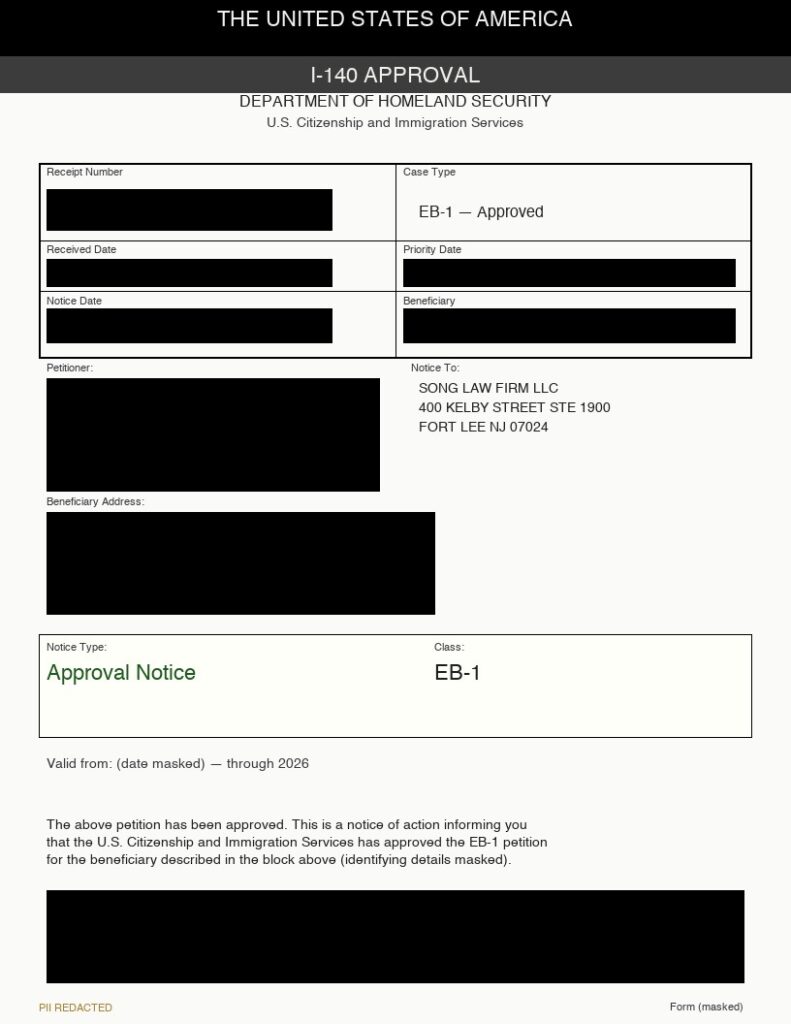
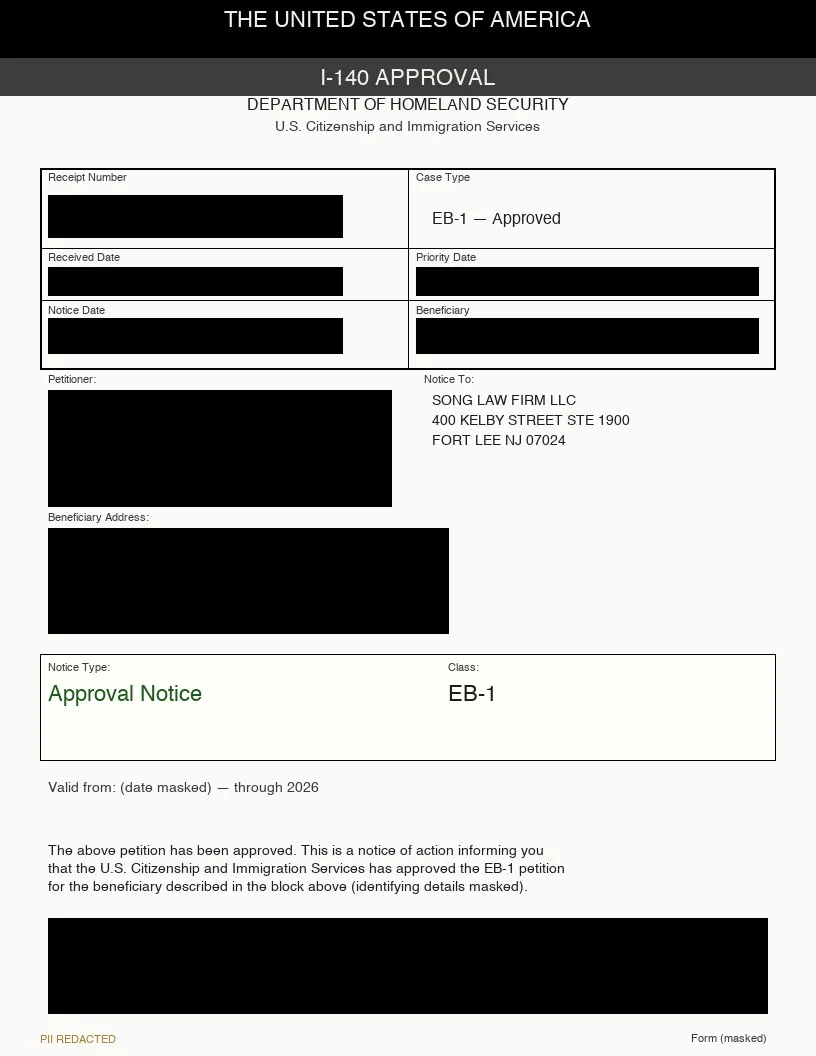
The client's I-140 EB-1 petition was approved and a Form I-797 approval notice was issued. The status extension was also approved so that activity continued without a status gap, and downstream green card proceedings continued according to the priority date.
Key Takeaways
EB-1 in the arts and design fields differs from STEM in that the central criteria are not publication and citation metrics, but rather the industry acclaim of creative activity — exhibitions, published material, awards, judging, and original contributions. Aligning the evidence to industry norms — the standing of press outlets, the international character of exhibitions, the recognition of judging activity, and market influence — determines the outcome. Designing the timeline of the EB-1 petition around the expiration of the existing nonimmigrant status is also of critical practical importance.
SONG LAW FIRM
Reviewing a similar immigration case? Schedule your consultation today.
📞 201.461.0031 · ✉ mail@songlawfirm.com · 🌐 songlawfirm.com
📍 Parker Plaza, 400 Kelby Street, Suite 1900, Fort Lee, NJ 07024
