
IMMIGRATION LAW · SONG LAW FIRM CASE STUDY
Client Profile
A Korean-American researcher in the 30s–40s range who obtained a Ph.D. in the humanities — literature, history, linguistics, cultural studies, or area studies — and was engaged with a U.S. university, research institute, or independent research project. Compared with STEM, access to quantitative metrics (citation indices, journal impact factors) differs; nonetheless, the case group obtained NIW approvals by reframing the significance of humanities research in terms of U.S. national interest. This case study reflects the common pattern of Song Law Firm's NIW matters in the humanities field.
Case Background
Relative to STEM, the burden of quantitative evidence is lower in the humanities, but the central issue is how to demonstrate the "national importance" of Prong 1 in a manner suited to the discipline. At the same time, given the impending expiration of the existing nonimmigrant status (H-1B, O-1, etc.), the status extension and NIW petition had to be designed in parallel.
Legal Requirements
The legal basis for NIW is INA § 203(b)(2)(B), and the standard for the waiver is the three-prong framework established in Matter of Dhanasar, 26 I&N Dec. 884 (AAO 2016).
① Substantial Merit and National Importance
② Well-Positioned to Advance the Endeavor
③ Beneficial to Waive the Job Offer and Labor Certification
USCIS Policy Manual Volume 6, Part F, Chapter 5(b) also addresses evaluation criteria for non-STEM fields, and the national-importance assessment for humanities, social science, and arts endeavors comprehensively considers the social, cultural, and educational impact of the endeavor and its contribution to policy and public discourse.
Song Law Firm's Strategy
Song Law Firm addressed the humanities-specific issues of the NIW as follows.
First, we reframed the national-importance argument — placing emphasis on social, cultural, and educational-policy impact rather than quantitative economic benefit. The client's endeavor was supported with reference to its contributions to U.S. cultural diversity, policy discourse, educational curricula, and public understanding, buttressed by government or institutional reports and industry research.
Second, we defined the endeavor — building the narrative around the question of which specific research, writing, teaching, or advisory endeavor is aligned with U.S. national interest, rather than resting on the degree itself.
Third, we developed prong 2 evidence — organizing the record of humanities journal and monograph publications, conference keynotes and invited talks, peer-review activity, graduate and undergraduate teaching, public lectures and media appearances, and government or nonprofit advisory activity.
Fourth, we compiled alternative evidence in place of citation metrics — because humanities citation data differs in accessibility from STEM, we assembled discipline-specific acclaim indicators such as citations in bibliographies, subsequent scholarship or translations, book reviews, curriculum adoption, and media mentions.
Fifth, expert letters — from prominent scholars in the same field and from adjacent policy and culture experts, we obtained opinion letters that supported the national importance of the endeavor and the client's position from multiple angles.
In parallel, we filed the status extension petition so that the proceedings continued without a status gap.
Case Processing and Timeline
Organizing the record and obtaining expert letters took several months, and the I-140 NIW petition was filed together with the status extension petition. Where Premium Processing was available, a prompt decision notice followed.
Result
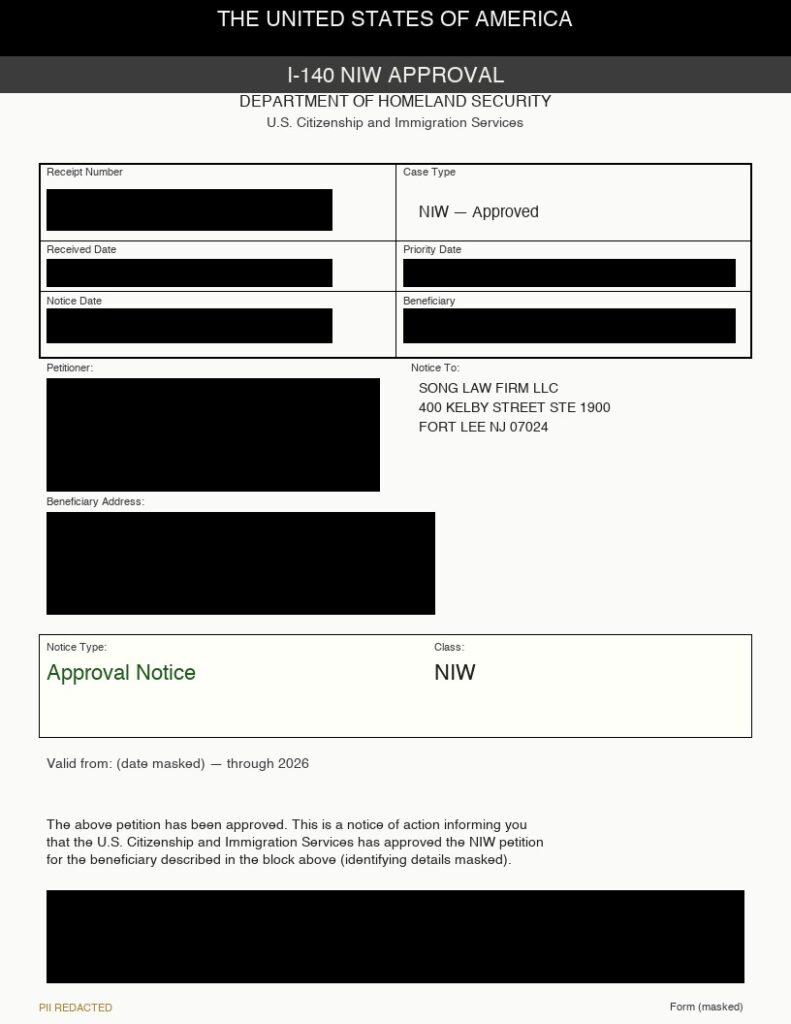
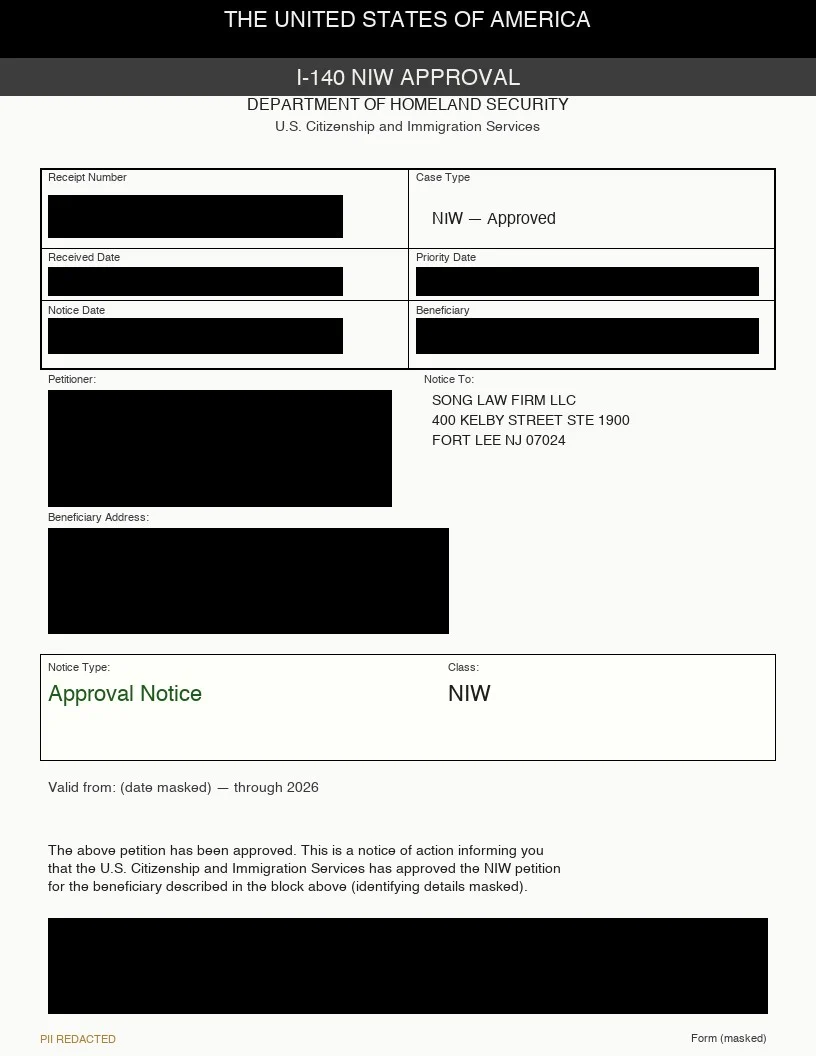
The client's I-140 NIW petition was approved and a Form I-797 approval notice was issued. The status extension was also approved so that activity continued without a status gap, and downstream green card proceedings continued according to the priority date.
Key Takeaways
NIW in the humanities requires a materially different evidence architecture from STEM. Redefining national importance in terms of cultural, social, and educational-policy impact and systematically organizing humanities-specific impact indicators — beyond publications, including lectures, advisory activity, and media presence — is what determines the outcome. Constructing a logical framework that applies the Dhanasar three-prong test to the discipline is central, and designing the timeline in parallel with the status extension is of critical practical importance.
SONG LAW FIRM
Reviewing a similar immigration case? Schedule your consultation today.
📞 201.461.0031 · ✉ mail@songlawfirm.com · 🌐 songlawfirm.com
📍 Parker Plaza, 400 Kelby Street, Suite 1900, Fort Lee, NJ 07024
