
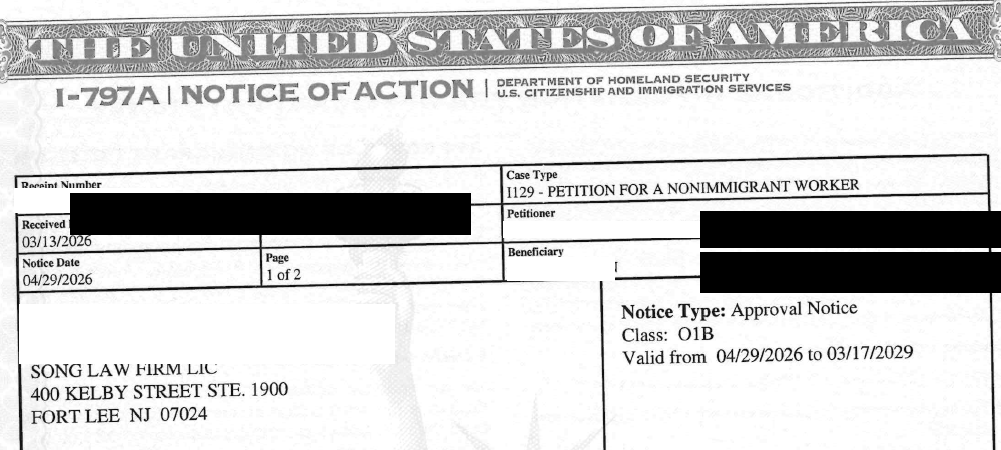
IMMIGRATION LAW · SONG LAW FIRM SUCCESS STORY
Client Profile
- Client of Asian origin, in late twenties
- Brought to the United States as a young child; approximately two decades of continuous U.S. residence
- New Jersey resident; college graduate now employed full time
- Established DACA recipient approaching a scheduled renewal cycle
Case Background
The client had grown up in the United States after arriving with parents at an early age, completing the entire course of American K-12 education and later earning a bachelor's degree. Employed full time in New Jersey, the client was maintaining an established DACA record and preparing for a routine renewal when a separate urgent matter arose. A grandparent living abroad experienced a serious health decline, and the family requested that the client travel overseas for a brief humanitarian visit. Because DACA recipients who depart the United States without prior authorization ordinarily forfeit their protection and can be barred from returning, a coordinated strategy combining a timely renewal with an Advance Parole petition (Form I-131) became essential. The client came to Song Law Firm several months before the renewal deadline, with a compressed window for the international travel.
Legal Issues
Several statutory and policy issues framed the case:
- DACA renewal criteria — continuous U.S. presence since the most recent grant, no disqualifying criminal record, and continued satisfaction of the education or employment prong. Each element required contemporaneous documentation.
- Advance Parole eligibility for DACA recipients — USCIS recognizes three grounds: humanitarian, educational, and employment. A grandparent's serious illness is a textbook humanitarian ground, but persuasive medical and relationship documentation, along with a clearly bounded travel plan, is required to secure both approval and expedited processing.
- Policy volatility — the DACA program has faced repeated litigation and administrative shifts. Initial DACA applications have been subject to periodic pauses under court order, while renewal filings for existing recipients have continued to be adjudicated. Choosing the correct category and framing the filing to the current program posture is a threshold strategic question, not a clerical detail.
- CBP discretion at reentry — an Advance Parole document authorizes an inspection encounter at a port of entry, but the ultimate decision to parole the individual back into the United States rests with U.S. Customs and Border Protection. Preparing the client for that inspection is as critical as securing the underlying approval.
Song Law Firm Strategy
Song Law Firm approached the matter as a single integrated filing package rather than a series of unrelated forms:
- Continuous residence dossier — school transcripts, employment W-2 records, tax filings, state identification records, medical records, and utility documentation were assembled year by year to create an unbroken evidentiary timeline covering every year since the most recent grant.
- Criminal-record clearance — even minor traffic and municipal matters were reviewed and cleared, confirming that nothing in the client's record could support an adverse discretionary decision.
- Humanitarian Advance Parole package — the petition combined certified medical documentation from the grandparent's physicians (with notarized translations), evidence of the family relationship, a proposed travel itinerary with a specific and clearly limited duration, a return ticket, and a written statement from the client explaining why an in-person visit was necessary.
- Reentry counseling — the client was briefed at length on how CBP inspections work, what documents to carry at the port of entry, and how to respond calmly to secondary inspection questions. The engagement emphasized, in writing and verbally, that Advance Parole approval is not itself a guarantee of admission but rather a status enabling an inspection.
Process
- Initial consultation and case assessment — approximately one week to complete the evidentiary intake
- Concurrent filing: Form I-821D (DACA renewal), Form I-765 (Employment Authorization), and Form I-131 (Advance Parole) with a humanitarian expedite justification
- USCIS biometrics appointment scheduled and completed on the earliest available date
- Advance Parole priority adjudication requested, supported by physician documentation and a written statement of urgency
- Advance Parole document issued; client departed the United States for the humanitarian visit within the planned window
- Return travel and CBP inspection at the port of entry — successful reentry as a parolee, no secondary complications
- DACA renewal and new EAD adjudicated and approved
Result
- DACA protection renewed with validity through June 2028
- New Employment Authorization Document issued, allowing uninterrupted employment
- Advance Parole document issued and successfully utilized; the client completed the family visit abroad and reentered New Jersey without incident
- Continued employment maintained without any disruption in payroll or authorization
Lessons
- For DACA recipients, international travel without prior Advance Parole authorization is high risk and can result in loss of status and inability to return. All travel plans should be discussed with counsel before any tickets are purchased.
- Renewal filings are most stable when initiated four to five months before the current expiration date. Filing at the last minute leaves no margin for RFEs, biometrics rescheduling, or unexpected agency slowdowns.
- The DACA program is one of the most policy-sensitive areas of U.S. immigration law. Recent court decisions and administrative memoranda materially affect which applications are being accepted and how they are prioritized. Continuous monitoring of the current USCIS posture is essential.
- Advance Parole approval is a permission to seek inspection, not a guarantee of admission. Careful preparation for the reentry inspection — appropriate documentation, a clear travel purpose, and calm engagement with CBP officers — is often what separates a smooth return from a difficult one.
- A single integrated filing strategy — renewal, employment authorization, and Advance Parole considered together with a unified evidentiary record — reduces adjudication friction and shortens the client's overall timeline compared with filing each piece separately.
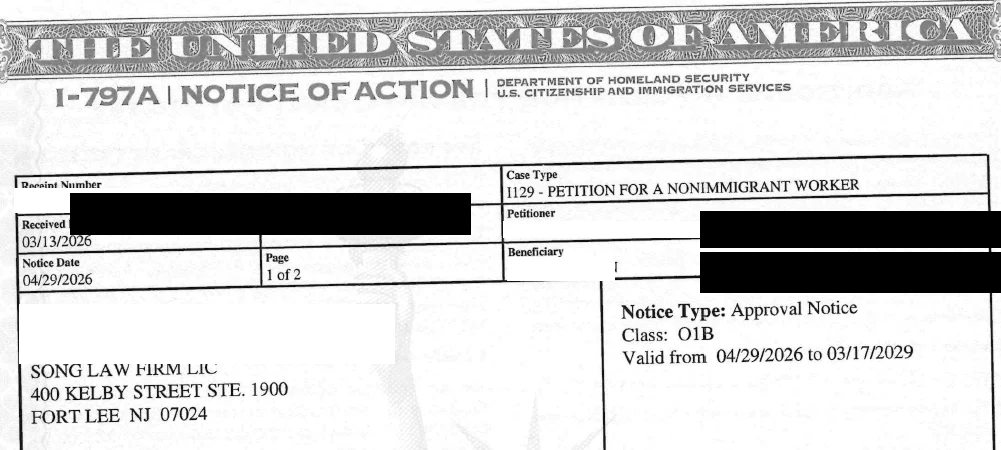
SONG LAW FIRM
Facing a similar immigration matter? Schedule a consultation today.
📞 201.461.0031 · ✉ mail@songlawfirm.com · 🌐 songlawfirm.com
📍 Parker Plaza, 400 Kelby Street, Suite 1900, Fort Lee, NJ 07024
