
IMMIGRATION LAW · SONG LAW FIRM SUCCESS STORY
Client Profile
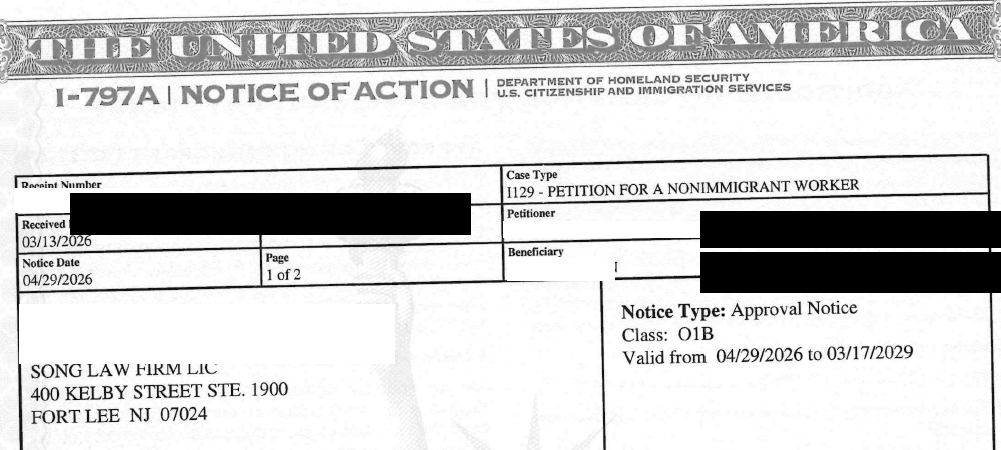
The client was a Korean-heritage professional in a STEM discipline with roughly eight years of research and development experience across US academic institutions and industry. Since first entering the United States, the client had held B-1, H-1B, and O-1 visas in sequence and ultimately sought permanent residency. Primary base of operations was a research and development organization in NJ, with an active collaboration relationship with a research center in MA.
Case Background
The client had already secured O-1 approval through prior counsel and was preparing the next step — an EB-1A petition. However, the evidence package the prior firm had assembled, while sufficient for O-1 standards, appeared inadequate for the EB-1A final merits determination. The client engaged Song Law Firm to take over representation, and we needed to preserve the value of the existing work product while reconstructing the evidentiary theory to meet EB-1A's higher bar.
Legal Issues
EB-1A is codified at INA 203(b)(1)(A) and is adjudicated under the two-step framework announced in Kazarian v. USCIS:
- Step 1: Whether the petitioner satisfies at least three of the ten regulatory criteria at 8 CFR 204.5(h)(3)
- Step 2: A final merits determination assessing whether the petitioner is among the "small percentage at the top" of the field, with sustained national or international acclaim
The O-1 evidence base cleared Step 1 without difficulty, but Step 2 sustained-acclaim analysis needed reinforcement. Concurrently, we had to manage status maintenance because the O-1 was set to expire before I-140 adjudication would likely complete.
Song Law Firm Strategy
Immediately after taking over, we ran three tracks in parallel:
- Evidence re-audit: We recategorized the existing exhibits under EB-1A criteria and identified priority gaps — original contributions of major significance, scholarly authorship, and judging roles required deeper documentation.
- H-1B backup track: In case of I-140 processing delays that would leave the client out of status when the O-1 expired, we prepared an H-1B transfer with a partner employer as a contingency.
- Premium processing: I-140 was filed with premium processing (15 business day guarantee), followed by concurrent I-485 filing to lock in adjustment of status jurisdiction.
Process
From counsel transfer to approval was approximately eight months. Mid-way, USCIS issued a Request for Evidence focused on the final merits — asking for additional proof that the beneficiary was in the small percentage at the top. We responded within ninety days with supplemental evidence including peer review invitations, international conference keynotes, industry standards committee participation, and quality media citations. Approval issued about six weeks after the RFE response.
Result
EB-1A approved in mid-2024. Because I-485 had been filed concurrently, the client obtained lawful permanent resident status without a lapse in valid status — the transition from O-1 to green card occurred seamlessly.
Lessons
Three takeaways emerged.
First, O-1 evidence does not carry over automatically to EB-1A. The categories share overlapping criteria but EB-1A's national or international acclaim standard is materially stricter, particularly at the final merits stage where sustained acclaim is required.
Second, counsel transfers carry hidden risk when the incoming firm simply builds on the prior firm's structure. A fresh audit through the destination category's lens produces stronger petitions.
Third, the combination of premium processing and concurrent filing is not merely a convenience — it is a status maintenance instrument. When a nonimmigrant visa is nearing expiration, that combination is often the difference between a clean transition and a period out of status.
FAQ
- Q: Can EB-1A be filed immediately after O-1 approval? A: Yes, but O-1 evidence must be recategorized and supplemented to meet EB-1A's higher standard.
- Q: Can a new firm inherit a prior firm's work product? A: Yes, if the client obtains the file. But a fresh audit is essential.
- Q: How long does EB-1A take? A: With premium processing on I-140, fifteen business days for I-140; six to twelve months for concurrent I-485. An RFE typically adds three to six months.
SONG LAW FIRM
Facing a similar immigration matter? Schedule a consultation today.
📞 201.461.0031 · ✉ mail@songlawfirm.com · 🌐 songlawfirm.com
📍 Parker Plaza, 400 Kelby Street, Suite 1900, Fort Lee, NJ 07024
