
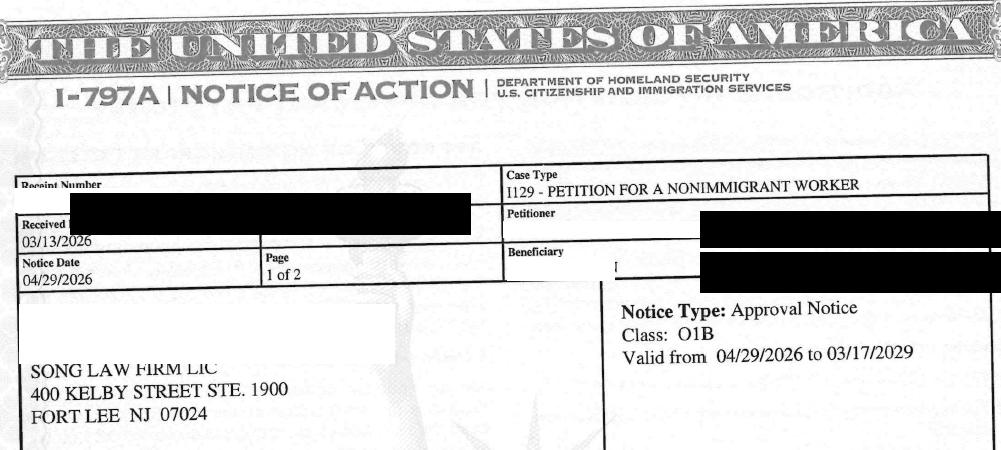
IMMIGRATION LAW · SONG LAW FIRM SUCCESS STORY
Client Profile
A Korean national employed as a software engineer at a mid-sized software company in New York State. After completing a U.S. undergraduate program in computer engineering and working under STEM OPT, the client sought long-term employment continuity through an H-1B cap petition. The employer was a first-time H-1B sponsor, requiring hands-on guidance through the process.
Case Background
H-1B follows an annual cycle: cap registration in early March, lottery results, and petition filing in April or later. Since the FY 2024 cap cycle, USCIS has enforced a strict one-registration-per-beneficiary rule. The client was successfully selected in the cap lottery, but the substantive petition review required rigorous demonstration of (1) the specialty occupation requirement and (2) a valid employer-employee relationship.
Legal Issues
Under INA 214(i) and 8 CFR 214.2(h)(4)(ii), the specialty occupation requirement is satisfied by meeting at least one of four prongs:
- A baccalaureate or higher degree, or its equivalent, is normally the minimum requirement for entry into the particular position
- The degree requirement is common to the industry in parallel positions, or the position is so complex or unique that it can only be performed by an individual with a degree
- The employer normally requires a degree or its equivalent for the position
- The nature of the specific duties is so specialized and complex that the knowledge required to perform them is usually associated with attainment of a baccalaureate or higher degree
While software engineer positions are generally recognized as satisfying the degree requirement, USCIS has increasingly scrutinized the specificity of job descriptions and the academic character of actual duties.
Song Law Firm Strategy
- Worked with the employer to rewrite the job description. Rather than a generic job-title recitation, the description was segmented by actual work items, with each item mapped to the theoretical foundations (data structures, algorithms, systems architecture) taught in a computer engineering curriculum.
- Documented the company's size, project complexity, and team structure to demonstrate that the software engineer position required substantive complexity within the employer's actual operations.
- Cited O*NET and BLS government sources to support the industry-wide degree requirement.
- Filed a Labor Condition Application (LCA) establishing that the offered wage met or exceeded the prevailing wage for the position and geographic area.
- Documented the employer-employee relationship through the internal employment contract, HR management structure, and reporting chain to a direct supervisor.
Process
Following successful cap selection, the I-129 petition was filed with Premium Processing in early April. USCIS approved the petition without issuing a Request for Evidence, and the client's I-94 was updated to reflect H-1B status with the start date carefully aligned to avoid any gap after STEM OPT expiration.
Result
The client secured H-1B status, providing up to six years of U.S. work authorization (initial three years plus a three-year extension). This established a foundation for future permanent residency pathways (PERM → I-140 → I-485) if desired, and the employer completed its first H-1B sponsorship successfully, building institutional capability for similar future cases.
Lessons
- Cap selection is only the gateway; the substantive petition review is the more significant hurdle. Do not become complacent after lottery selection — prepare the petition record with equal rigor.
- The specialty occupation requirement lives or dies on the fit between the job description and the degree requirement. Generic titles are insufficient; segment actual duties and connect each to the academic curriculum.
- Wages must meet or exceed the prevailing wage for the position and geographic area, and the LCA and supporting documentation must be accurate.
- For first-time employer sponsors, education on the process and hands-on document-preparation support are essential.
For H-1B cap petitions, first-time sponsor guidance, cap-exempt petitions, and extensions or transfers in New Jersey and New York, Song Law Firm's immigration team provides comprehensive counsel.
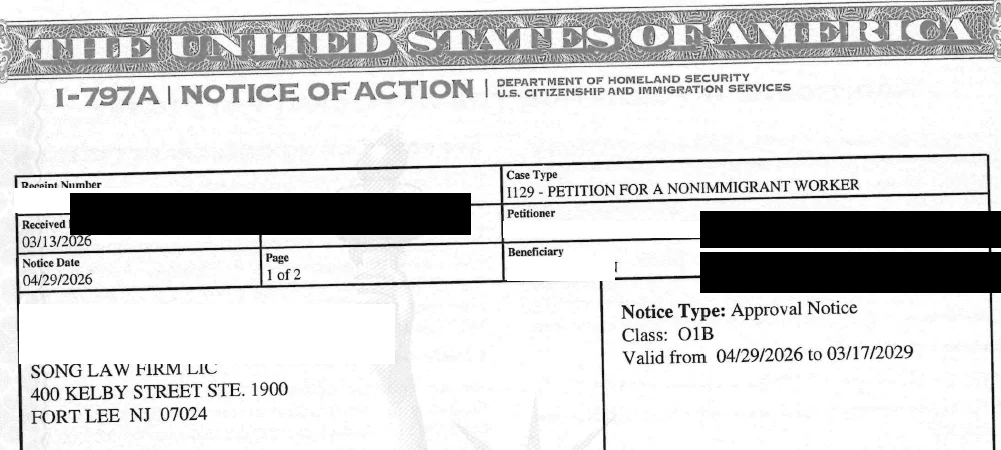
SONG LAW FIRM
Facing a similar immigration matter? Schedule a consultation today.
📞 201.461.0031 · ✉ mail@songlawfirm.com · 🌐 songlawfirm.com
📍 Parker Plaza, 400 Kelby Street, Suite 1900, Fort Lee, NJ 07024
