
IMMIGRATION LAW · SONG LAW FIRM CASE STUDY
Client Profile
A Korean-American creator in the 30s–50s range who has worked as a producer, director, or creative head in the film and TV industry and earned international acclaim. Their track record includes invitations to and awards from international film festivals, profiles and reviews in major press outlets, commercial and critical success of the works they contributed to, and recognition from adjacent creators. A number of clients had initiated EB-1A petitions with another firm and, following the issuance of an RFE, found the response difficult and transferred the case to Song Law Firm.
Case Background
In film and TV, EB-1A petitions cannot rely on the publication and citation metrics typical of academic fields, but must instead build the evidentiary axis around critical and press coverage, awards, commercial and critical success, and recognition from adjacent creators. Where these field-specific characteristics were not sufficiently reflected in the initial petition, RFEs were often issued, and obtaining approval required reconstructing the field-specific facts and legal argument at the RFE response stage.
Legal Requirements
The legal basis for EB-1A is INA § 203(b)(1)(A); 8 C.F.R. § 204.5(h); and the Kazarian v. USCIS, 596 F.3d 1115 (9th Cir. 2010) two-step analysis. The legal basis for the RFE procedure is 8 C.F.R. § 103.2(b)(8), with related procedures set out in USCIS Policy Manual Volume 1, Part E. Among Kazarian step 1's 10 criteria, the items particularly meaningful in the film and TV field include published material, awards, judging, original contributions, leading/critical role, high salary, and commercial success in the performing arts.
Song Law Firm's Strategy
After the case transfer, Song Law Firm proceeded as follows.
First, initial petition review — we reviewed the prior firm's petition submission, the RFE notice, and the evidence already submitted, and precisely diagnosed the issues raised by the adjudicator. Typically, the issues arose along two axes: (a) the qualitative weight of the evidence mapped to each criterion, and (b) the insufficiency of the "sustained acclaim" and "top of the field" showing at step 2 Final Merits.
Second, field-specific reframing — we prepared a brief explaining to the adjudicator the industry standards for assessing acclaim in film and TV (the standing of press outlets, the tier of film festival invitations, the nationally or internationally recognized character of awards, and the industry context of commercial performance).
Third, RFE response evidence supplementation — we collected additional press archives, international film festival programs and invitations, awards selection criteria, opinion letters from adjacent creators, and industry-data support for commercial and critical success.
Fourth, RFE response brief — we constructed legal and factual arguments that squarely addressed each issue raised by the adjudicator. Citing the Kazarian opinion and the USCIS Policy Manual, we requested reassessment of the qualitative weight of each criterion and, at step 2 Final Merits, visualized the client's activity on a timeline to support the "sustained" element.
Fifth, expert opinion letter expansion — we expanded the letters beyond authorities in the same field to include experts in adjacent fields (criticism, media, and cultural policy) to support that the client's influence extended within and beyond the industry.
Case Processing and Timeline
Immediately following retainer execution, we fixed the initial petition review and RFE response timeline, and evidence collection, brief drafting, and review took several weeks to several months. Supplemental evidence and the brief were submitted to USCIS ahead of the RFE response deadline.
Result
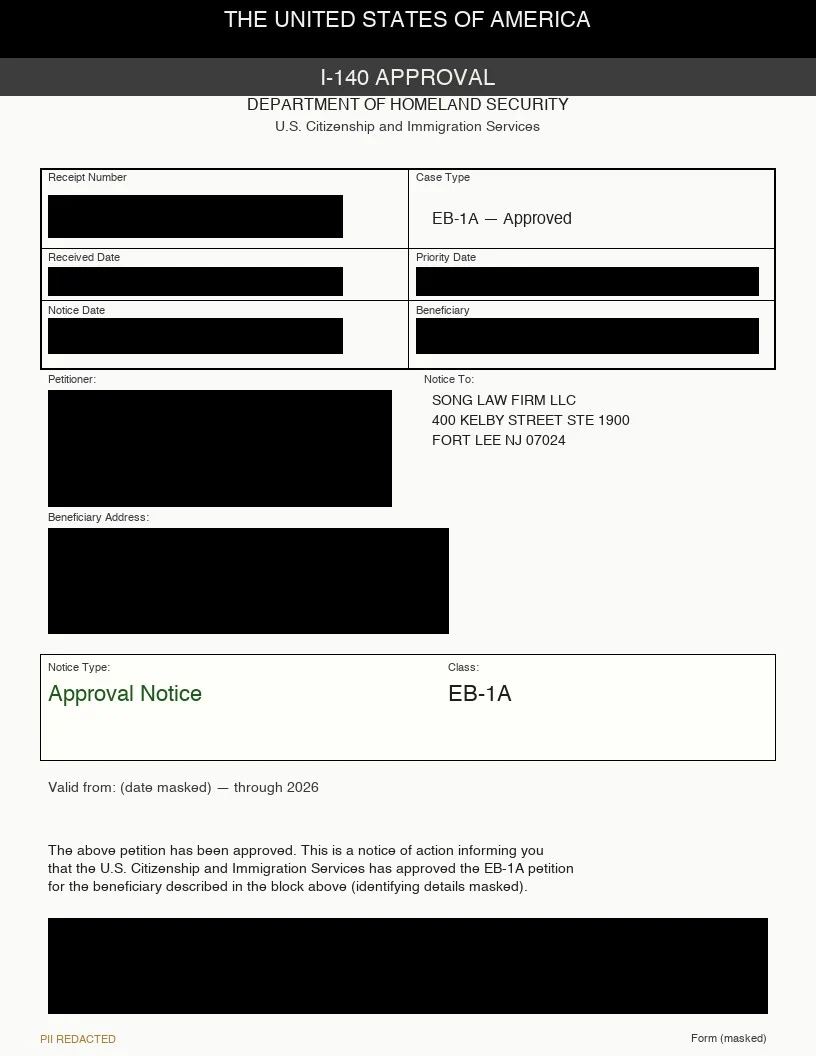
Following the RFE response, the client's I-140 EB-1A petition received the final approval notice. Following approval, the matter proceeded to I-485 or consular processing depending on the priority date.
Key Takeaways
EB-1A in the film and TV field requires an evidence architecture materially different from that of the academic profile. In RFE-issued cases, the outcome turns on the precise diagnosis of the issues raised by the adjudicator and the clear explanation of field-specific acclaim indicators. Even after a case transfer, reorganizing the initial evidence and drafting a brief aligned with industry standards can lead to approval, and this demonstrates that cases where the initial firm's approach fell short remain recoverable.
SONG LAW FIRM
Reviewing a similar immigration case? Schedule your consultation today.
📞 201.461.0031 · ✉ mail@songlawfirm.com · 🌐 songlawfirm.com
📍 Parker Plaza, 400 Kelby Street, Suite 1900, Fort Lee, NJ 07024
