
IMMIGRATION LAW · SONG LAW FIRM CASE STUDY
Client Profile
A Korean-American client in the 20s–40s range working in a U.S. professional field, holding a four-year bachelor's degree and engaged in a specialized job. Many had built their U.S. careers through F-1, OPT, and H-1B status, and their situations included an employer transfer during the green card process. This case study reflects the common pattern of Song Law Firm's EB-3 professional worker matters involving an employer transfer.
Case Background
The common situation of the client group was that during the green card process (PERM → I-140 → I-485), a change of employer became necessary for various reasons. The backgrounds included corporate mergers and acquisitions, departmental restructuring, individual career transitions, or shifts in the sponsoring company's circumstances. The key issue was how to design the employer transfer while preserving the continuity of the green card process.
Legal Requirements
The legal basis for EB-3 is INA § 203(b)(3). Among the three sub-categories — Skilled Worker, Professional, and Other Worker — the Professional Worker category requires a U.S. bachelor's degree or foreign equivalent and a specialized job. Procedural regulations are found at 20 C.F.R. § 656 (PERM), 8 C.F.R. § 204.5(l) (I-140), and INA § 245 (I-485).
The legal basis for employer transfer is AC21 § 106(c) — after the I-485 has been pending for 180 days, portability to a same or similar occupation is permitted, with detailed regulations at 8 C.F.R. § 245.25.
Song Law Firm's Strategy
Song Law Firm designed the EB-3 procedure and the employer transfer scenario together.
First, we diagnosed transfer feasibility by procedural stage — whether restart is required and the associated risk differ depending on whether the transfer occurs during the PERM, I-140, or I-485 stage. Because PERM is employer-specific, it must in principle be re-filed; at the I-140 stage, priority date retention is available; and after the I-485 has been pending 180 days, AC21 § 106(c) portability offers a different option.
Second, we leveraged priority date retention — where the original sponsor's I-140 is approved and remains valid, the original priority date can be carried over into the new sponsor's new petition (8 C.F.R. § 204.5(e)). This minimized backlog loss.
Third, we analyzed same or similar occupational classification — where AC21 portability was invoked, we performed a comprehensive comparison of the old and new job duties, SOC code, required education and experience, and wage level to prepare the Form I-485 Supplement J filing.
Fourth, we collaborated with the new sponsor — organizing the new sponsor's job offer letter, evidence of the ongoing enterprise, and intent to employ as record evidence.
Fifth, we prepared for RFEs — because adjudicators may issue RFEs on same-or-similar determinations, the new sponsor's business substantiality, and portability requirements in employer transfer cases, we prepared supporting materials in advance.
Case Processing and Timeline
After retainer execution, procedural-stage diagnosis, priority date treatment decisions, coordination with the new sponsor, and evidence assembly took several months. The new I-140 petition or Supplement J submission was made, and after adjudication, the decision was issued.
Result
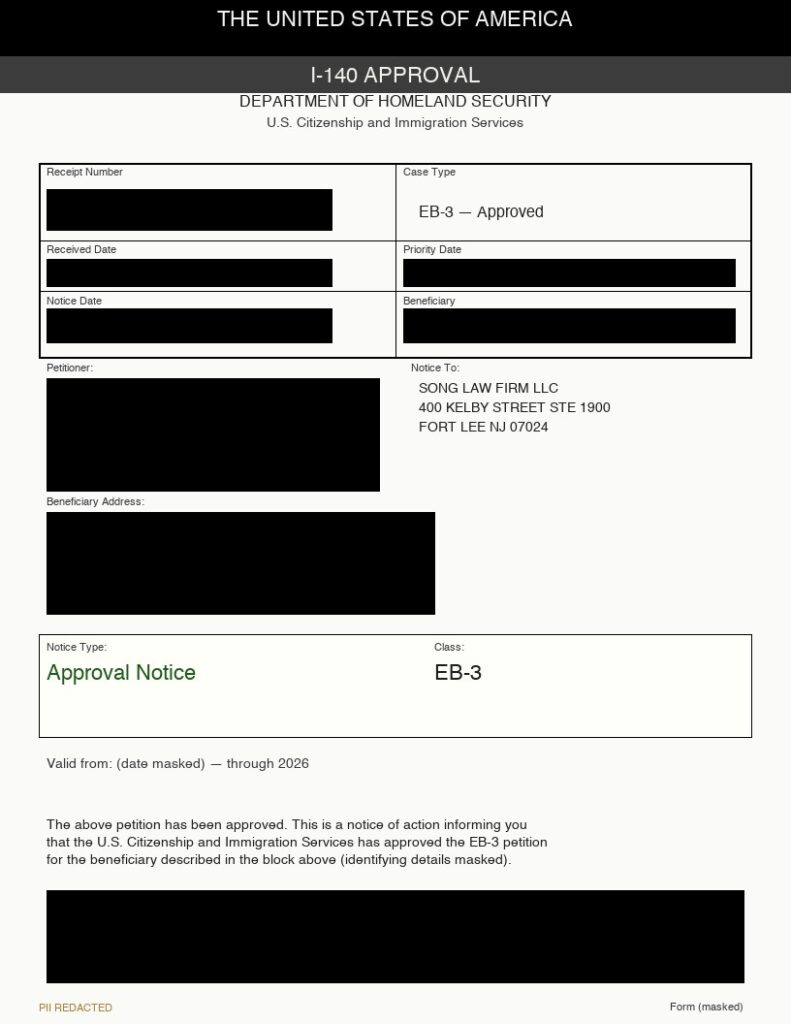
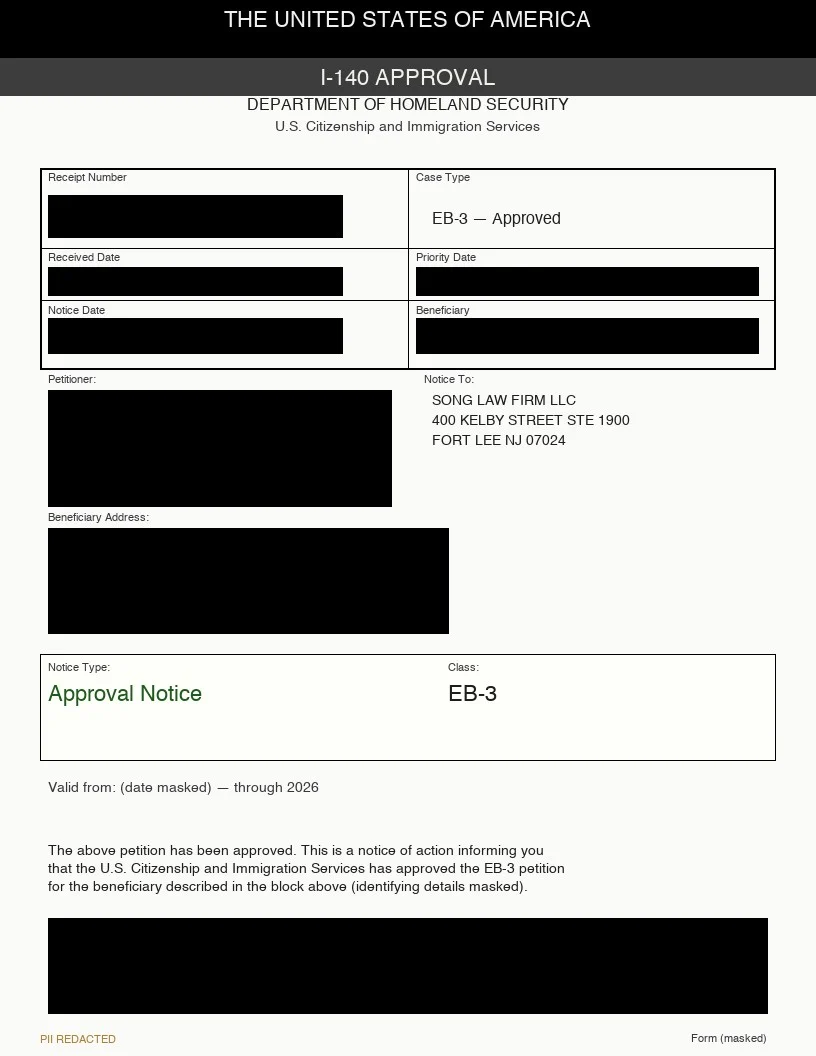
The client's EB-3 process maintained continuity through the employer transfer and ultimately received the final approval notice, and at the point the priority date became current, the I-485 was approved and lawful permanent residence was obtained.
Key Takeaways
An employer transfer during the EB-3 process presents very different options depending on the procedural stage. Re-filing is the rule at the PERM stage, but after I-140 approval the powerful options of priority date retention and AC21 portability become available. Collaboration with both the original and new sponsors, accurate procedural-stage diagnosis, and precise same-or-similar analysis determine the outcome. When a transfer is anticipated, early consultation is the key to minimizing backlog loss and procedural delay.
SONG LAW FIRM
Reviewing a similar immigration case? Schedule your consultation today.
📞 201.461.0031 · ✉ mail@songlawfirm.com · 🌐 songlawfirm.com
📍 Parker Plaza, 400 Kelby Street, Suite 1900, Fort Lee, NJ 07024
