
IMMIGRATION LAW · SONG LAW FIRM CASE STUDY
Client Profile
A Korean-American client in the 20s–40s range holding a degree and qualification in the nursing field, who encountered a ground of inadmissibility under the Immigration and Nationality Act during the U.S. employment-based or family-based green card process, making it impracticable to obtain lawful permanent residence without a waiver. Grounds of inadmissibility can arise in various forms, including prior unlawful presence, certain misrepresentations, or specific criminal history. This case study reflects the common pattern of Song Law Firm's I-601 waiver matters for clients in the nursing field.
Case Background
The client group's proceedings had been suspended at the final stage of the green card process (either a consular interview or I-485 adjudication) when a ground of inadmissibility was identified. A representative type of inadmissibility is the 3-year/10-year bar under INA § 212(a)(9)(B), which is automatically triggered upon re-entry when a person has accrued unlawful presence in the United States for a specified period. Overcoming this bar requires a waiver — that is, a petition to have the ground of inadmissibility waived.
Legal Requirements
The legal basis for the I-601 waiver is INA § 212(a)(9)(B)(v), with procedural regulations at 8 C.F.R. § 212.7. The requirements for approval are as follows.
① Qualifying relative — a U.S. citizen or lawful permanent resident spouse or parent (children are generally not qualifying relatives, though this varies by waiver type).
② Extreme hardship — demonstration that the qualifying relative would suffer extreme hardship if the waiver were denied.
③ Discretionary approval — the case must warrant a favorable exercise of USCIS discretion (positive factors must outweigh negative factors).
The standard for extreme hardship draws on the factors established in Matter of Cervantes-Gonzalez, 22 I&N Dec. 560 (BIA 1999), and is elaborated in USCIS Policy Manual Volume 9, Part B, Chapter 5.
Song Law Firm's Strategy
Song Law Firm organized the extreme hardship showing into the following factor groups.
First, health factors — the qualifying relative's medical condition, ongoing treatment needs, and comparison of medical accessibility in the United States versus Korea or overseas. We attached physician letters, diagnoses, and prescription records.
Second, financial factors — the qualifying relative's financial stability in the United States, and the income loss, support burden, difficulty in servicing mortgage or other debt, and potential asset loss that would occur upon separation. These were documented with records.
Third, emotional and psychological factors — for the psychological hardship arising from separation, we obtained an evaluation letter from a psychiatrist or licensed mental health counselor. Attaching an objective clinical evaluation, rather than mere emotional narrative, proved decisive.
Fourth, country conditions — evidence of the hardship the qualifying relative would face if relocating abroad with the client (language, culture, safety, healthcare, education, etc.).
Fifth, educational and social factors — the continuity of the children's education, the gap between U.S. and other school systems, and loss of social networks.
Because each factor is not evaluated in isolation but rather in the aggregate, the core of the strategy was to weave multiple factors into a single narrative and construct a brief that conveys to the adjudicator the totality of the hardship.
Case Processing and Timeline
After retainer execution, collecting the qualifying relative's documentary, medical, financial, and psychological evaluation materials took several weeks to several months. Following preparation of the extreme hardship brief draft and review meetings with the client and qualifying relative, the final package was submitted to USCIS. Where supplemental evidence was requested during adjudication, we promptly submitted supplements.
Result
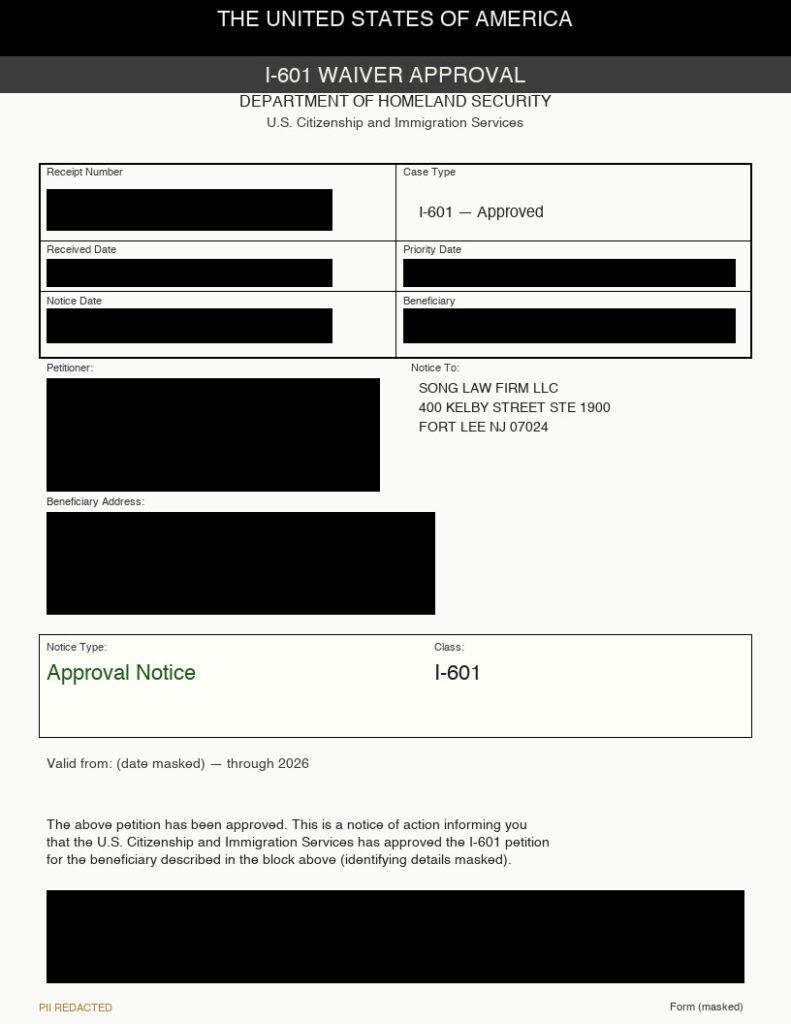
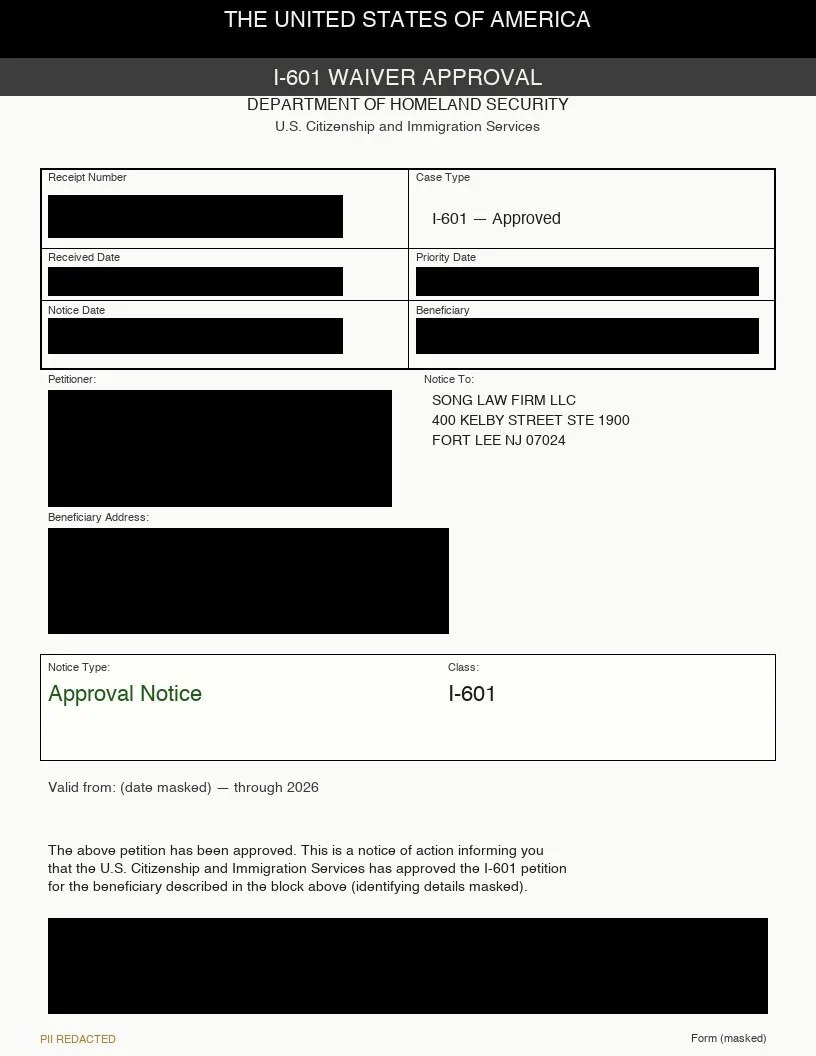
The client's I-601 waiver petition was approved and a Form I-797 approval notice was issued. Following the waiver approval, the suspended green card proceedings resumed, and — depending on the immigrant category — either the consular interview or I-485 adjudication continued.
Key Takeaways
An I-601 waiver is not granted merely on the basis of a marriage or family relationship. The extreme hardship showing is not a list of individual factors but an aggregate narrative demonstrating that the totality of the qualifying relative's situation rises to extreme hardship. The objectivity of the medical, financial, psychological, and country-conditions evidence and the logical integration of the brief are what determine the outcome.
SONG LAW FIRM
Reviewing a similar immigration case? Schedule your consultation today.
📞 201.461.0031 · ✉ mail@songlawfirm.com · 🌐 songlawfirm.com
📍 Parker Plaza, 400 Kelby Street, Suite 1900, Fort Lee, NJ 07024
