
IMMIGRATION LAW · SONG LAW FIRM CASE STUDY
Client Profile
A Korean-American chef in the 30s–40s range who has built a long career in Korea or overseas and secured international recognition. The client had accumulated reviews in the gastronomy press, culinary competition and award records, recognition in the international Michelin-tier evaluation system or equivalent, and roles as head chef or executive chef at renowned restaurants. This case group needed O-1B status for a new U.S. restaurant opening, pop-up projects, or consulting engagements.
Case Background
Whether culinary arts falls within the O-1B "arts" category has been debated in practice. USCIS clarifies at 8 C.F.R. § 214.2(o)(3)(ii) that "arts" is a broad concept encompassing fine arts, visual arts, culinary arts, and performing arts, so that culinary arts squarely qualifies for the O-1B. The practical question, therefore, is how to structure the evidence so that the chef's creative expression and expertise rise to the level of a distinguished reputation.
Legal Requirements
The legal basis for O-1B is INA § 101(a)(15)(O); 8 C.F.R. § 214.2(o). The evaluation standard is set out at 8 C.F.R. § 214.2(o)(3)(iv) with two evidentiary options.
① A major, internationally recognized award — an Academy Award, Grammy, or comparable award (the culinary-field equivalent must be assessed).
② Three or more of six criteria — a lead or starring role in distinguished productions or events; critical reviews; a lead or critical role in distinguished organizations; major commercial or critically acclaimed success; recognition from organizations, government, or critics; and high salary.
An advisory opinion must also be obtained from the relevant peer group or organization (for the culinary field, an associated chefs' association or culinary industry organization).
Song Law Firm's Strategy
Song Law Firm structured the chef's O-1B evidence as follows.
First, critical reviews — restaurant reviews, chef profiles, and interviews published in the gastronomy press (newspapers and magazines), together with appearances on culinary programs and documentaries, were collected. We documented the standing of the publications, the reviewer's professional standing, and whether the review referenced the chef personally.
Second, lead/starring role in distinguished productions or events — head-chef and executive-chef roles at restaurants that earned Michelin-star or comparable recognition, invitations to international culinary festivals as a featured chef, guest-chef collaborations, and lead roles at pop-up events were documented.
Third, awards — culinary competition wins, industry awards, and national, regional, or international culinary honors were substantiated together with the publishing outlets and selection criteria.
Fourth, recognition from organizations/government/critics — membership or honorary standing in culinary associations, government cultural or tourism commendations, and separate recognition from prominent critics was collected.
Fifth, lead/critical role in distinguished organizations — the client's leadership role in restaurant groups and consulting projects was documented with employer letters.
Sixth, high salary — the client's compensation level relative to industry benchmarks in the culinary field was documented with wage surveys and contracts.
We also engaged in advance with the relevant chefs' associations and culinary industry organizations to prepare the advisory opinion letter.
Case Processing and Timeline
Organizing the record and obtaining the advisory opinion took time, and the Form I-129 O-1B petition was filed. Where Premium Processing was available, a prompt decision notice followed.
Result
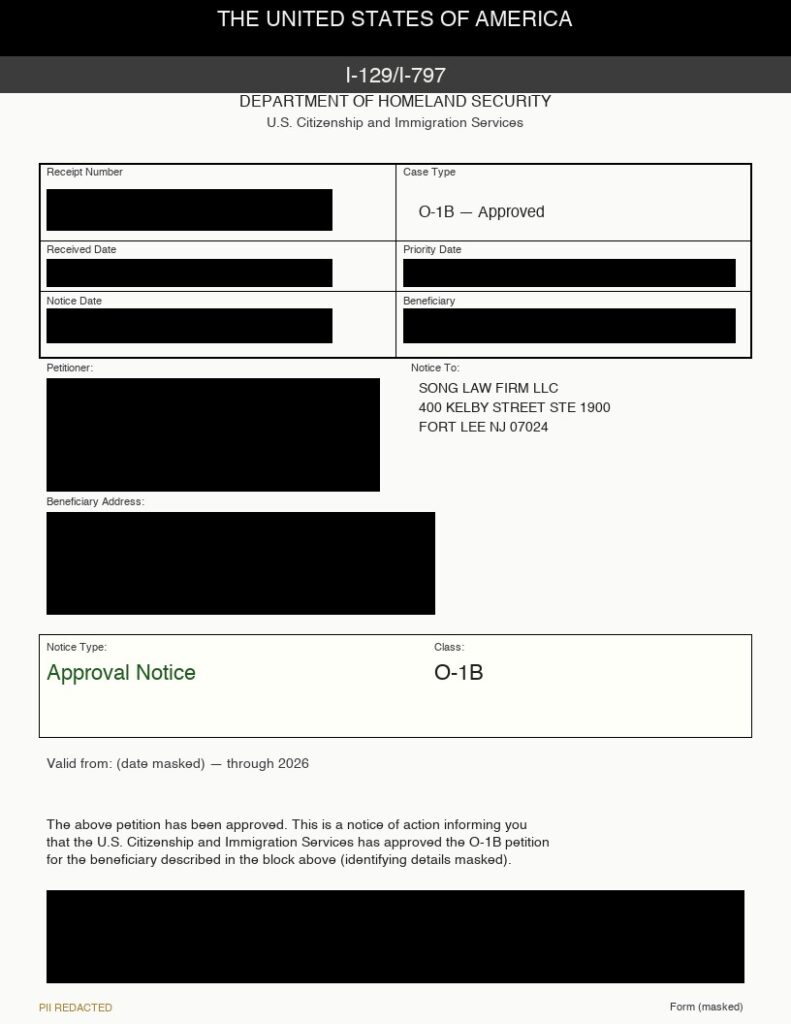
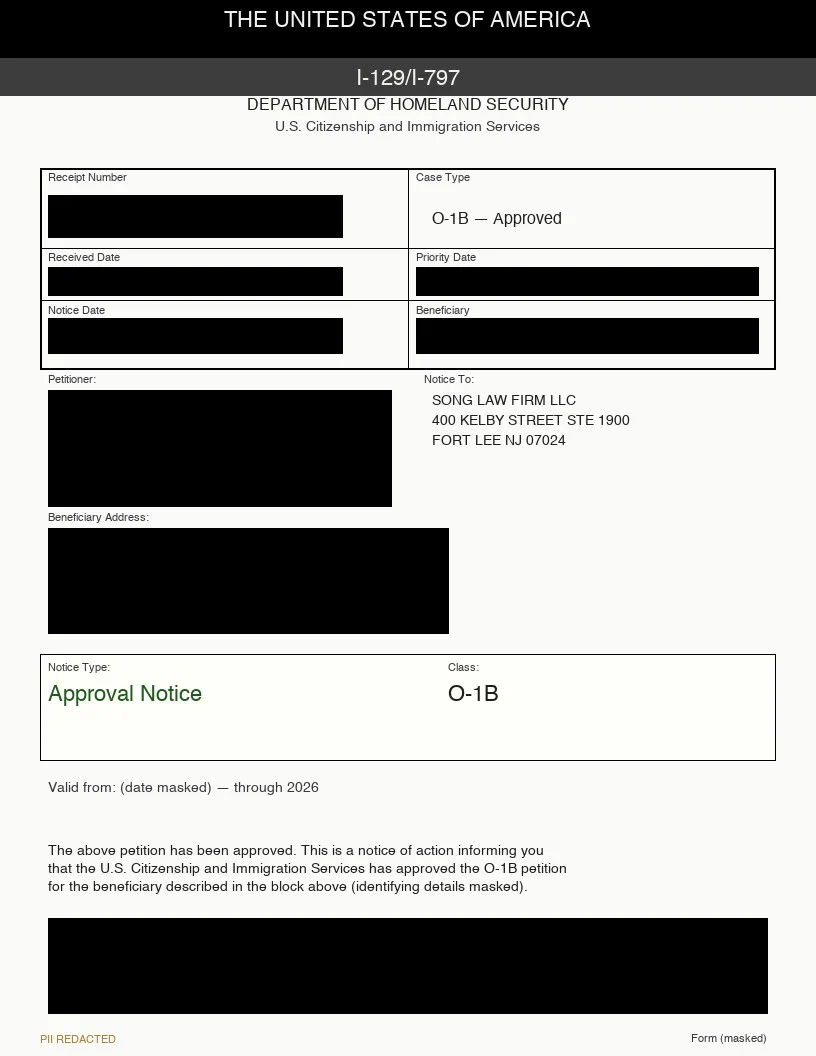
The client's O-1B petition was approved and a Form I-797 approval notice was issued. The client proceeded with U.S. restaurant activity, consulting projects, and pop-up events in O-1B status, and we advised on planning for renewal or transition to a green card path.
Key Takeaways
Culinary arts clearly falls within the O-1B "arts" category, but proving a chef's distinguished reputation requires systematically organizing culinary-specific acclaim indicators — gastronomy press reviews, Michelin-tier evaluation, culinary competitions and awards, and industry-body recognition. Selecting the appropriate industry organization for the advisory opinion and engaging with it in advance is also of critical practical importance.
SONG LAW FIRM
Reviewing a similar immigration case? Schedule your consultation today.
📞 201.461.0031 · ✉ mail@songlawfirm.com · 🌐 songlawfirm.com
📍 Parker Plaza, 400 Kelby Street, Suite 1900, Fort Lee, NJ 07024
