
IMMIGRATION LAW · SONG LAW FIRM SUCCESS STORY
Client Profile
The client was a Korean-heritage professional with internationally recognized standing in the client's discipline. The client had activity experience across multiple countries and had made several short business visits to the United States on B-1, but had never held long-term nonimmigrant status. The client planned to establish a US presence in NJ with a collaboration relationship in MA and sought permanent residency.
Case Background
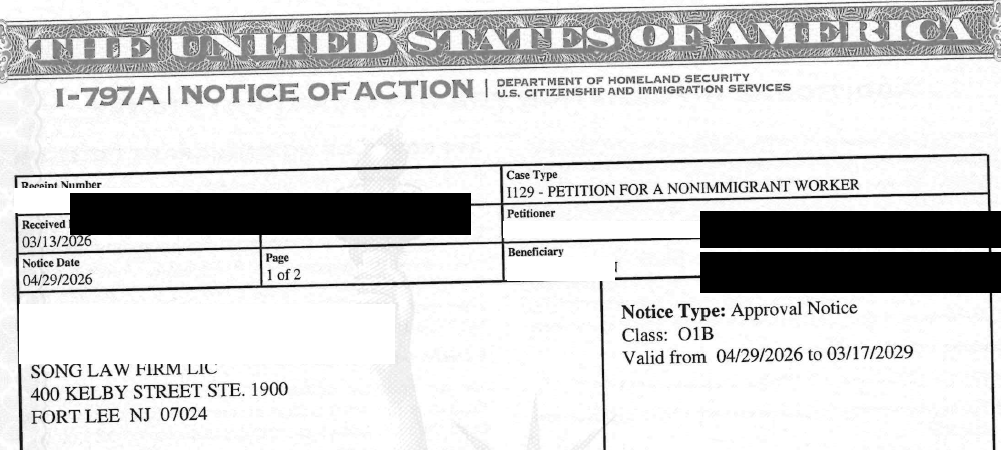
Prior counsel had been preparing an O-1 petition when the client engaged Song Law Firm. On review of the client's file, we assessed that the documented international awards and sustained acclaim were strong enough to support a direct EB-1A filing. While the conventional path is O-1 first for status stability followed by EB-1A, the strength of this client's international recognition made the direct EB-1A route faster.
Legal Issues
EB-1A Step 1 under Kazarian asks whether at least three of the ten regulatory criteria at 8 CFR 204.5(h)(3) are satisfied. This client naturally cleared five criteria:
- (i) Receipt of internationally recognized awards for excellence
- (ii) Membership in associations requiring outstanding achievements
- (iii) Published material in professional or major trade publications about the client
- (v) Original contributions of major significance
- (viii) Command of a high salary substantially higher than others in the field
Step 1 was cleared comfortably, so the case turned on the Step 2 final merits determination. USCIS does not count criteria arithmetically at Step 2 — it makes a holistic judgment about whether the beneficiary is among the small percentage at the top of the field with sustained national or international acclaim.
Song Law Firm Strategy
After taking over representation we executed the following:
- Layered documentation of international awards using original certificates, event programs, media coverage, and judging panel rosters
- Formal translation and notarization of association bylaws and membership criteria demonstrating that admission required outstanding achievement judged by recognized experts
- Six expert opinion letters, each backed by the recommender's own CV establishing peer status
- A separate final merits brief laying out the logical case for sustained acclaim at the top of the field
- Premium processing on the I-140 for a 15 business day decision
Process
From counsel transfer to approval, approximately six months. USCIS approved at the initial adjudication stage without issuing an RFE. Concurrent I-485 was already prepared and filed with the premium-processed I-140. The clarity of the international recognition documentation left little room for the adjudicator to require supplementation.
Result
EB-1A approved in mid-2024. Concurrent I-485 adjudication produced lawful permanent resident status. The case illustrates that a client with only B-1 visitor history can still obtain a green card via EB-1A, provided the underlying record of extraordinary ability is well documented.
Lessons
First, when documented international awards and sustained acclaim are clearly strong, filing EB-1A directly can be faster and less expensive than routing through O-1 first.
Second, a separate final merits brief materially improves outcomes. Making the adjudicator's holistic analysis easier — by laying out the logic explicitly — matters at the Step 2 stage.
Third, expert opinion letters do not help by volume. Six to eight letters from true peer reviewers with independent credentials carry more weight than a larger stack of general endorsements.
FAQ
- Q: Is EB-1A available to someone with only B-1 visits? A: Yes. EB-1A does not require US residence history — it evaluates only extraordinary ability and sustained acclaim.
- Q: Direct EB-1A vs O-1 first? A: Direct is faster but requires stronger evidence. When the record is borderline, O-1 first is safer for status stability.
- Q: Is premium processing required? A: Not required, but the decision predictability and generally higher-caliber adjudicator assignment make it advisable in most EB-1A cases.
SONG LAW FIRM
Facing a similar immigration matter? Schedule a consultation today.
📞 201.461.0031 · ✉ mail@songlawfirm.com · 🌐 songlawfirm.com
📍 Parker Plaza, 400 Kelby Street, Suite 1900, Fort Lee, NJ 07024
