
IMMIGRATION LAW · SONG LAW FIRM CASE STUDY
Client Profile
A Korean national in the 30s–40s range working in the content and media industry, who combined personal capital with partner capital to establish or acquire a U.S. business entity operating in film and TV production. After building a career in Korea as a producer, planner, or production professional, the client decided to enter the U.S. market and required a nonimmigrant status to sustain continuing activity in the United States. This case study consolidates the common pattern observed across Song Law Firm's E-2 matters in the content and entertainment field.
Case Background
The client group had established or acquired a business entity in the United States for purposes such as operating a production company, developing projects, or distributing overseas content in the U.S. market, and needed a status that would allow them to personally direct and develop the enterprise. The E-2 is a nonimmigrant visa that permits nationals of a treaty country to enter the United States to develop and direct a substantial investment enterprise, and Korea is among the treaty countries with the United States.
Legal Requirements
The legal basis for the E-2 is INA § 101(a)(15)(E)(ii), with procedural regulations at 8 C.F.R. § 214.2(e) and Foreign Affairs Manual 9 FAM 402.9. The core requirements are as follows.
① Treaty country nationality — the client must hold nationality of a treaty country such as Korea.
② Substantial investment — the capital committed must be substantial relative to the scale of the enterprise (proportionality test).
③ At-risk and irrevocably committed — the capital must be subject to loss and irrevocably committed to the enterprise.
④ Bona fide enterprise — the entity must be a real, operating business.
⑤ Not marginal — the enterprise must not exist solely to earn a living for the investor and family (must have capacity for profit generation or U.S. job creation).
⑥ Develop and direct — the client must actually develop and direct the enterprise (typically 50% or more ownership or effective operational control).
Song Law Firm's Strategy
Song Law Firm addressed the industry-specific issues that arise for E-2 petitions in the content and entertainment field as follows.
First, we adjusted the substantiality argument to reflect industry economics. Film and TV production, unlike traditional manufacturing or distribution, often shows a lag between initial capital outlay and revenue recognition. We therefore aggregated development costs, pre-production expenses, talent contract retainers, licenses, equipment, office lease, legal and accounting fees, and other documented expenditures and contracts to construct the substantiality argument.
Second, to address the marginality requirement, we prepared a U.S. job creation plan (five-year business plan) and an early project pipeline record. Planned projects, contracted creative team members, distribution agreements, and MOUs were assembled to demonstrate that the enterprise is not marginal.
Third, we traced the investment funds to demonstrate the at-risk requirement. We documented the trail from Korean-won assets → bank wire transfer → U.S. business account → business-purpose disbursements, and distinguished loan proceeds by whether they were personally collateralized in a manner consistent with the at-risk standard.
Fourth, to satisfy the develop-and-direct requirement, we ensured that the client's effective managerial control was clearly reflected in the corporate bylaws, shareholder ledger, board resolutions, and operating agreement.
Fifth, to demonstrate actual business activity, we submitted the lease agreement, business registration, EIN, bank account opening documents, and early contracts, invoices, and payroll records.
Case Processing and Timeline
The client engaged Song Law Firm after having completed the U.S. entity formation and initial investment deployment. After reviewing the business structure and cleaning up the equity arrangement, we determined the E-2 filing path — either a U.S.-based change of status via Form I-129 or consular processing at the U.S. Embassy in Seoul — based on the client's circumstances. Preparation of the evidence package (business plan, financial records, investment fund trail, contract documents) took several weeks, and a decision notice was issued after filing.
Result
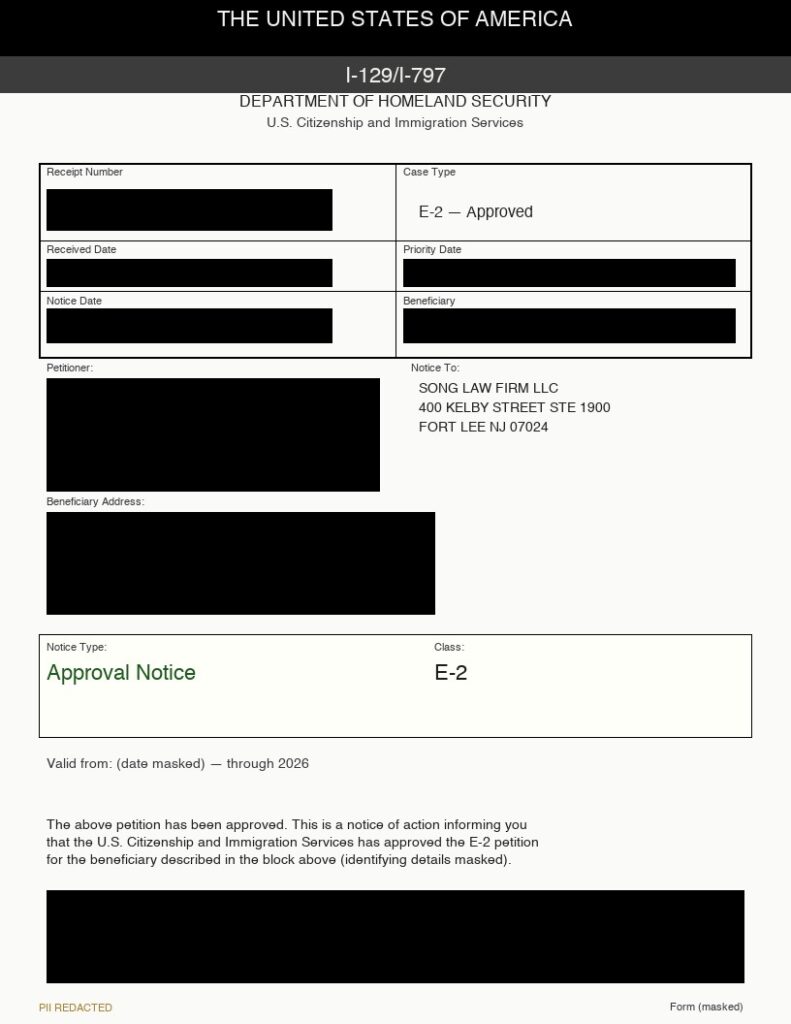
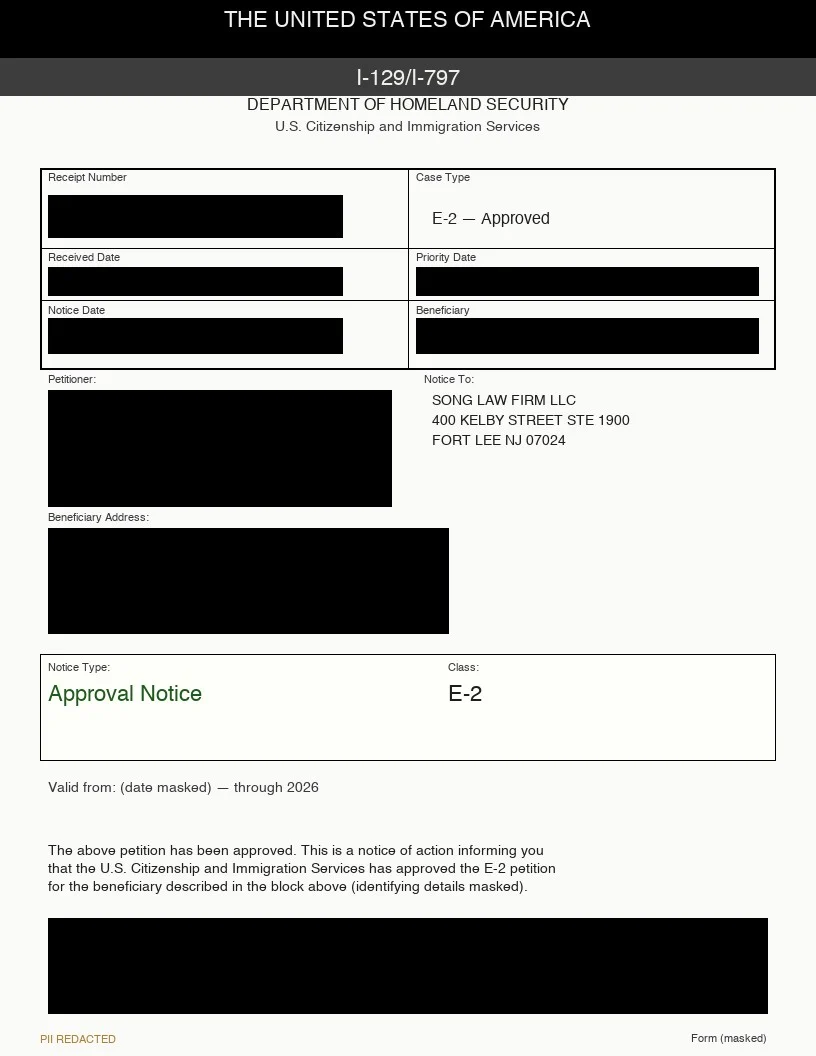
The client's E-2 petition was approved, resulting in a Form I-797 approval notice (for the change-of-status route) or issuance of the E-2 visa by the consulate. The spouse became eligible for E-2 dependent (E-2S) status with U.S. employment authorization, and children were registered as E-2 dependents. We advised the client on the planned execution of two-year E-2 renewals going forward.
Key Takeaways
The E-2 treaty investor visa succeeds when the substantiality and marginality arguments are tailored to the economics of the content and entertainment industry. It is essential to explain to the adjudicator that this industry inherently involves a lag between capital outlay and revenue recognition, while simultaneously presenting evidence of actual U.S. business activity and a job creation plan. The clarity of the investment fund trail and the explicit reflection of the develop-and-direct requirement are what determines approval.
SONG LAW FIRM
Reviewing a similar immigration case? Schedule your consultation today.
📞 201.461.0031 · ✉ mail@songlawfirm.com · 🌐 songlawfirm.com
📍 Parker Plaza, 400 Kelby Street, Suite 1900, Fort Lee, NJ 07024
