
IMMIGRATION LAW · SONG LAW FIRM CASE STUDY
Client Profile
A Korean-American client in the 20s–40s range engaged in a creative or technical specialty in the film and TV industry. The client held at least a bachelor's degree in a related major, was regularly employed by a U.S. production company, studio, or post-production company, and consulted Song Law Firm ahead of the expiration of the initial three-year H-1B period, when a three-year extension was required. This case study reflects the common pattern of Song Law Firm's H-1B extension matters in the film and TV field.
Case Background
The client group was continuing U.S. activity in H-1B status and needed a three-year extension within the six-year cap. Because the film and TV industry can face relatively strict adjudicator scrutiny of the specialty occupation requirement (a position requiring at least a bachelor's degree in a specific field) compared to standard IT or engineering fields, demonstrating the linkage between job duties and required education became central.
Legal Requirements
The legal basis for H-1B is INA § 101(a)(15)(H)(i)(b), with procedural regulations at 8 C.F.R. § 214.2(h). The specialty occupation definition is set out at 8 C.F.R. § 214.2(h)(4)(ii) and 20 C.F.R. § 655.715, requiring satisfaction of at least one of the following four criteria.
① A bachelor's or higher degree, or its equivalent, is normally the minimum entry requirement for the position.
② The degree requirement is common to parallel positions in the industry, or the position is so complex or unique that it can be performed only by a degree holder.
③ The employer normally requires a degree or its equivalent for the position.
④ The specific duties of the position require knowledge associated with attainment of a bachelor's degree.
The LCA (Labor Condition Application) follows 20 C.F.R. § 655 Subpart H, requiring prevailing wage compliance and notice of working conditions. Extension petitions are governed by 8 C.F.R. § 214.2(h)(15).
Song Law Firm's Strategy
Song Law Firm organized the evidence tailored to H-1B extension in the film and TV field as follows.
First, specialty occupation showing — we supported through a detailed job description letter from the employer how the client's job duties link to specific major knowledge (film production, editing, visual effects, sound design, production management, and comparable degree-based expertise).
Second, industry-standard evidence — the degree-requirement practice for parallel positions within the film and TV industry was documented through industry association materials, job posting analysis, and industry research reports.
Third, client's major and career linkage — the linkage between the client's bachelor's or master's major and current job duties was documented together with credential evaluation or degree records.
Fourth, LCA management — prevailing wage determinations for the work location, LCA notice posting, and public access file management, among the employer-side compliance items, were re-verified.
Fifth, extension petition — the basis for the initial H-1B approval, the client's work performance during the prior period, and the continued need for employment were organized and clearly reflected in the extension petition.
Sixth, parallel green card design — for clients approaching the six-year cap, we also advised in advance on the availability of AC21 § 104(c) or § 106(a) through parallel PERM and I-140 filings.
Case Processing and Timeline
After retainer execution, evidence collection, employer collaboration, and brief drafting took several weeks, and following LCA approval, the Form I-129 H-1B extension petition was submitted. Where Premium Processing was available, a prompt decision notice followed.
Result
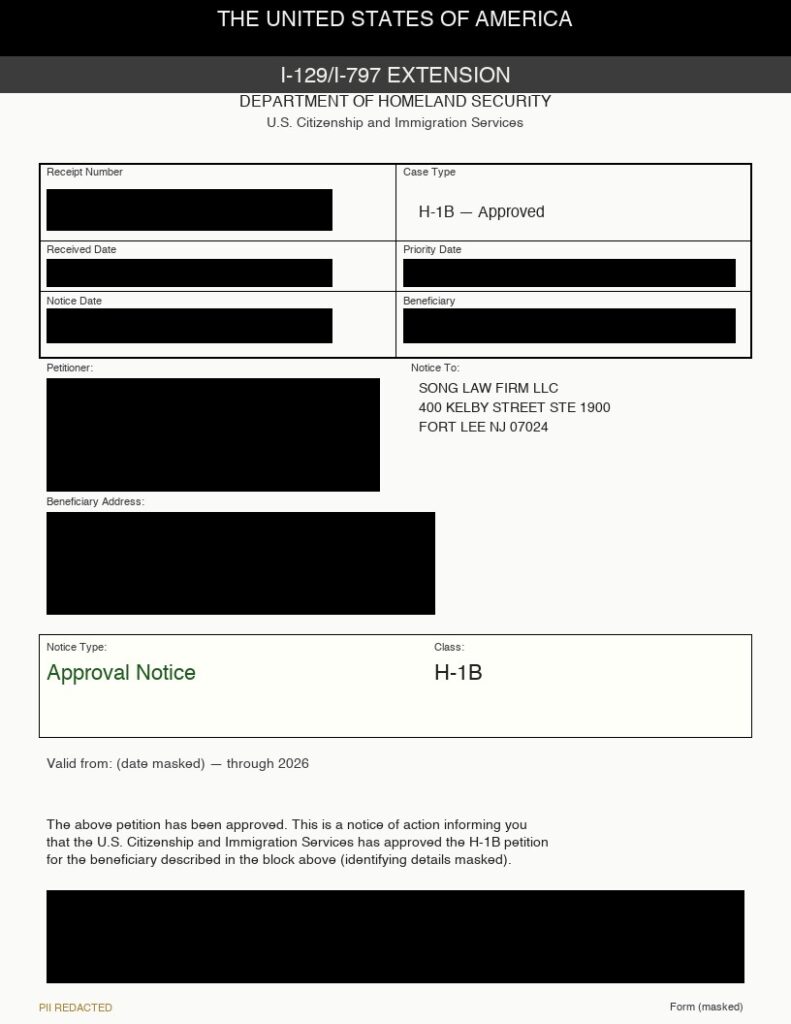
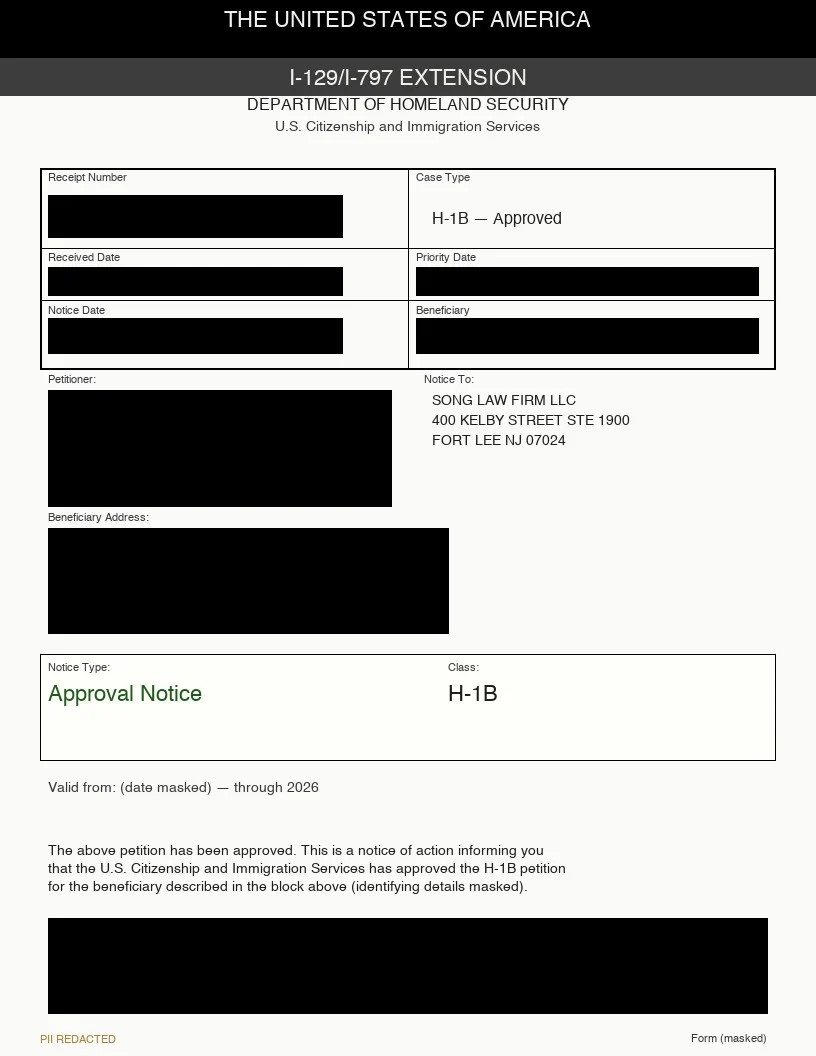
The client's H-1B extension petition was approved and a Form I-797 approval notice was issued. The client continued film and TV project work throughout the three-year extension without any interruption of status, and we advised on planning green card proceedings in advance of the six-year cap.
Key Takeaways
H-1B extension in the film and TV field turns on a clear specialty-occupation showing. Only when the linkage between job duties and degree-based knowledge, industry-standard practice, and the degree-requirement evidence for parallel positions is organized in tandem can the adjudicator be informed about the industry-specific nature of the position. Designing green card proceedings to run in parallel while leveraging the extension timing is also of critical practical importance.
SONG LAW FIRM
Reviewing a similar immigration case? Schedule your consultation today.
📞 201.461.0031 · ✉ mail@songlawfirm.com · 🌐 songlawfirm.com
📍 Parker Plaza, 400 Kelby Street, Suite 1900, Fort Lee, NJ 07024
